|
|
|
|
|
 |
|||
|
|
|
|
|
|
|
|||
| Click Here For Full Artist Print Indexes | Aviation History Archive |
|
Aviation Art Prints  Countries US Aircraft Index Countries US Aircraft Index  Thunderbolt Thunderbolt |
[UP] - Mustang - Flying Fortress - Thunderbolt - Corsair - Lightning - Liberator - Dakota - Phantom - More Aircraft |
| Navigation | |
| Page 1 of 2 | Page 1 .. Next |
|
|
|
|
|
|
|
|
|
|
|
|
|
|
|
|
|
|
|
|
|
| Navigation | |
| Page 1 of 2 | Page 1 .. Next |
| Text for the above items : |
Tigers at Rest by Stan Stokes. No text for this item |
Duxford Pair by Ivan Berryman. These Republic P-47D Thunderbolts were operational with the 82nd FS, 78th FG based at Duxford during the final months of the war in Europe. |
Thunderbolt Strike by Robert Taylor. A flight of P47 thunderbolts of the 404 Fighter group, 9th Air force, clear the target area after a low-level attack on the airfield inland from Le Havre, Normandy, 1944. Tracer winds up towards them from ground defences and almost all the aircraft have taken hits. Ground-attack pilots went in low, did the job and got our fast! |
Zemke's First Fan by David Pentland. On the 12th of May 1944, Col. Hubert Zemke tried his new fan tactic, designed to engage Luftwaffe fighters. Unfortunately on this occasion his aircraft was bounced by German ace Major Gunther Rall in his ME109 G-6AS, and escaped only by sending his P47-D Thunderbolt into a gut wrenching dive. |
Return From Bremen by Simon Smith. The leading ace of the mighty Eighth Air Force, Gabby Gabreski. He finished the war with a total of 28 air victories and 2 1/2 enemy aircraft destroyed on the ground by strafing airfields. Gabreski also scored 6 1/2 air victories in the Korean war. |
Eagle Strike by Simon Atack. Flying his Messerschmitt Me109G6, Major Gunther Rall, Group Commander of II./JG11 with over 200 air victories already to his credit, clashes with a P-47 Thunderbolt of the 63rd Sqn, 56th Fighter Group high over the Rhine south of Koblenz, May 12, 1944. Led by Colonel Hub Zemke, the 56th Fighter Group played advance guard to a deep penetration bomber raid to central Germany. As his forty eight P-47 Thunderbolts arrived to sweep the sky around the Koblenz - Frankfurt area, the Me109s of II./JG11 pounced from a 5000 feet height advantage. Simon Atacks high-impact painting shows Major Gunther Rall bringing down Hub Zemkes wingman, the first of two victories he claimed before himself being brought down by 56th Fighter Group P-47s later in the combat. Gunther Rall returned to combat flying, commanding JG300 until the end of hostilities by which time, with 275 air victories, he became the third highest scoring Ace in history. |
Tribute to Walker 'Bud' Mahurin by Ivan Berryman. Flying P-47 Thunderbolts with the 56th Fighter Group in England, Bud Mahurin scored more than 20 victories during World War Two. Seen here in his personal aircraft 42-8487 UN-M named The Spirit of Atlantic City owing to it being paid for by bonds from that city, he shot down three Me109s in a day and three Fw190s another day, before eventually being brought down by return fire from a German bomber. Evacuated from France with the help of the Resistance, he then flew P-51 Mustangs against the Japanese in the Philippines, scoring one more victory before again being shot down, bailing into the ocean. He went on to score more victories in the Korean War before being shot down and taken prisoner for more than a year. He was the only pilot of the US Air Force to down enemy aircraft in the European Theater, Pacific Theater and Korean War. He died in 2010. |
Tribute to Robert S Johnson by Ivan Berryman. American fighter Ace Robert S Johnson is depicted in his 56th Fighter Group P-47 Thunderbolt with codes HV-P named 'Lucky'. Of his 27 victories during a tour of 89 combat missions from April 1943 to May 1944, he scored 21 in this aircraft. The joint sixth top-scoring American Ace of WW2, he was notably the first US pilot in the European theater to better the historic WW1 victory total of Eddie Rickenbacker, the top-scoring American Ace of that war. Post-war, he became a test-pilot and retired in 1962. He died in 1998. |
Thunder in the Ardennes by Anthony Saunders. P-47 Thunderbolts of the 509th Fighter Squadron, 405th Fighter Group, pass low over paratroopers of the 82nd Airborne Division advancing through heavy snow during the Battle of the Bulge, January 1945. Major Robert 'Blackie' Blackburn, in his distinctive aircraft Chow Hound, leads his unit as they head out on a morning low-level bombing mission. In the early hours of 16th December 1944, out of nowhere, hundreds of panzers and thousands of troops poured forward as Hitler launched the last great German offensive of the war and, for once, the Allies had been wrong-footed. The thinly-held Ardennes was the last place they had been expecting a counter-attack, but now three German armies were heading west across an 80-mile front. Caught off guard the Americans rushed in reinforcements, including the 82nd and 101st Airborne Divisions encamped near Reims, over a hundred miles away. Exhausted by the fighting in Holland during Operation Market Garden, they had been sent to Reims to recuperate. They never got the chance. Thrown into the thick of the action the 82nd helped to blunt the Germans' advance to the north, whilst at Bastogne, a pivotal town further south, the 101st, surrounded, out-numbered and besieged, refused to surrender. The line held and three days before Christmas the panzers ground to a halt, stalled by lack of fuel. As the weather improved the Allies could now bring their airpower into play. Hitler's last gamble had failed. |
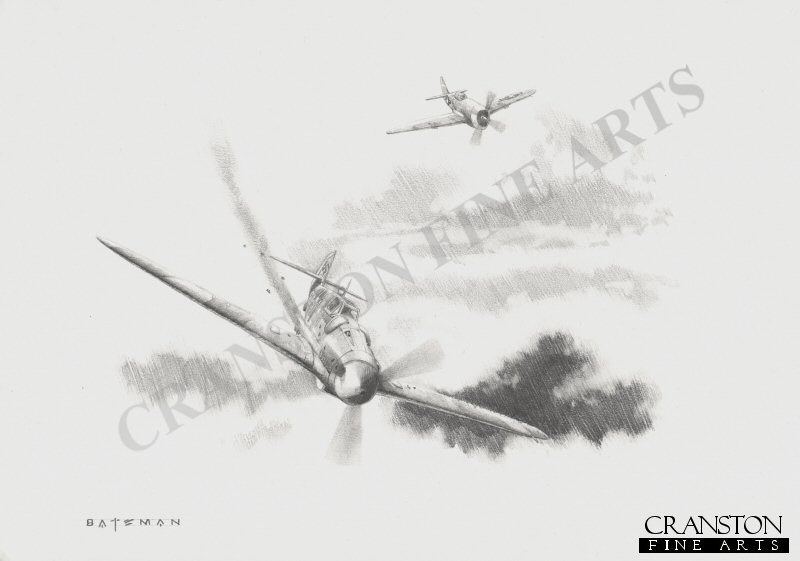
Victory for Red Section by Brian Bateman. Steve Pisanos, flying P-47 QP-D in Red Section, shoots down a German Me-109 near Sittard, Gemany. Here we see the 109 trailing smoke and banking down as Steve has hits near the engine and cockpit of the enemy combatant. Claim one Me-109. |
Herky's Big Day by Stan Stokes. The Republic P-47 Thunderbolt, or Jug7 as it was more popularly called, was the mount of many of the American aces of WW 11. The P-47 represented the crowning achievement from two aircraft designers, Alexander Kartvelli and Alexander De Seversky, both immigrants from Russia. It came on the heels of two other aircraft, the P-35 and P-43, which were satisfactory pre-war designs, but not up to the new standards required to compete against Bf-109 fighters in Europe or Mitsbushi Zeroes in the Pacific. The P-47 was the largest and heaviest single seat American fighter of the War. Powered by a huge 2000-HP radial engine, more than 15,000 Jugs were produced. The first production variant was the P-47B which had a razorback fuselage. During tests the aircraft attained a speed of 429-MPH with a maximum range at 10,000 feet of 835 miles. Later variants included a C and D model with the razorback fuselage. Belly tanks and wing tanks became standard equipment as the range of this fighter was stretched for bomber escort missions in Europe. In mid- 1943 one of the biggest pilot complaints about the aircraft was remedied when a bubble top canopy and redesigned fuselage was incorporated into the D model. This dramatically improved rearward vision of the pilots. These aircraft were armed with 8 machine guns, and could carry up to 2500 pounds of additional fuel or ordinance. Herschel Herky Green was one of the top USAAF aces in Europe with a total of 18 confirmed aerial victories (3 in P-40s, 10 in P-47s, and 5 in P-5 Is.) Green was born in 1920 in Mayfield, Kentucky. While studying mechanical engineering at Vanderbilt University he learned to fly in the Civilian Pilot Training Program. He joined the Army as an aviation cadet in 1941 and earned his wings an a commission at Foster Field in 1942. One of Greens first assignments was flying P40s in North Africa. He scored a total of three victories in P-40s before his squadron transitioned to the Jug. As depicted in Stan Stokes painting, appropriately entitled Herkys Big Day, Green downed six enemy aircraft on one mission over Northern Italy on January 30, 1944. Greens flight initially encountered a group of Ju-52 transports, and Green bagged four of them. About thirty minutes later the ace encountered a lone Macchi 202. In a low level turning duel Green eventually got in position and nailed the Italian fighter. Its wing dipped, caught the ground, and sent the Macchi into a terrible cartwheel of destruction. Heading home Green encountered a Do-217, which quickly became victim number 6. Green went on to later add four more P-47 victories, and after his group changed to the P-51 he scored an additional five, making him an ace in both the Jug and the Mustang. Green remained in the Air Force following the War, serving as Deputy Commander of the 4th Fighter Group at Selfridge Field. He also held a number of important staff positions prior to his retirement in 1964. Since that time he has been a successful businessman. Greens numerous decorations include the Distinguished Service Cross, Silver Star, Distinguished Flying Cross with Oak Leaf Cluster, the Purple Heart, The Air Medal with 25 Oak Leaf Clusters, and the French Croix de Guerre with Palm. Green resides in Southern California. |
Bridge Busting Jugs by Stan Stokes. Alexander Kartveli was a engineer with Seversky Aircraft who designed the P-35, which first flew in 1937. With Republic Aviation Kartveli supervised the development of the P-43 Lancer. Neither of these aircraft were produced in large numbers, and neither was quite successful. However, the Republic Aviation P-47 Thunderbolt, also nicknamed the Jug, was quite a different story. The Jug was the jewel in Kartvelis design crown, and went on to become one of the most produced fighter aircraft of all time with 15,683 being manufactured. The P-47 was the largest and heaviest single seat fighter of WW II. The P-47 immediately demonstrated its excellent combat qualities, including speed, rate of climb, maneuverability, heavy fire power, and the ability to take a lot of punishment. With a wingspan of more than 40 feet and a weight of 19,400 pounds, this large aircraft was designed around the powerful 2000 HP Pratt and Whitney R-2800 Double Wasp radial engine. The first P-47 prototype flew in May of 1941, and the primary variant the P-47D went into service in 1943 with units of the U.S. Armys Eighth Air Force. The Jug had a maximum speed in excess of 400 MPH, a service ceiling in excess of 42,000 feet, and was heavily armed with either six or eight heavy caliber machine guns. With its ability to carry up to a 2,500 pound bomb load, the Jug saw lots of use in ground attack roles. Until the introduction of the N model, the P-47 lacked the long range required for fighter escort missions which were most often relegated to P-51 Mustangs or P-38 Lightnings. In his outstanding painting entitled Bridge Busting Jugs, noted aviation artist Stan Stokes depicts Eighth Air Force Jugs in a ground attack mission in the Alps in June of 1944. The top P-47 ace was Francis Gabreski who had flown with the 56th Fighter Group, the first unit to be equipped with the P-47. In August of 1943 Gabreski attained his first aerial combat victory (over an Fw-190) and by years end he had reached ace status with 8 confirmed victories. As Commander of the 61st Squadron, Gabreski continued to chalk up victory after victory, and on seven different occasions he achieved two victories during the same mission. However, in July of 1944 Gabreski damaged the prop on his Jug during a low level attack on an airfield near Coblenz. Forced to make a crash landing, he was captured and remained a prisoner of war until Wars end in 1945. Following the War Gabreski returned to military service with the Air Forces 4th Fighter-Interceptor Wing in Korea. Flying the F-86 Sabre Jet, Gabreski attained 6.5 more aerial victories in 1951 and 1952 becoming an ace in two different wars. |
Greek Victory by Brian Bateman. Steve Pisanos, flying P-47 QP-D, is depicted pulling away swiftly after a victory over an FW-190 in late December 1944 over northern Germany. This was Steve's fourth victory, one victory short on an ace, which would come later in the P-51. |
Hell Hawks Over Utah by Robert Taylor. Without air supremacy D-Day and the invasion of north-west Europe would never have happened, and the tactical Ninth Air Force played a huge part in securing that position. The Ninth had fought with distinction from the deserts of North Africa to the invasion of Sicily and the fighting in Italy. They had spearheaded the assault on Ploesti and, from humble beginnings, had grown into one of the finest and most formidable Air Forces in the USAAF. Then, in October 1943, the Ninth were sent to England for their greatest challenge so far - providing air support for the US First Army during the forthcoming invasion of Normandy. By the morning of 6th June 1944 the Ninth was the largest and most effective tactical air force in the world, with over a quarter of a million personnel and more than 3,500 fighters, bombers and troop-carriers under its command. Amongst them were the P-47s of the 365th Fighter Group - the fearsome Hell Hawks - a unit that by the end of World War Two would become legendary. Amongst the first to use P-47s as fighter-bombers, the Hell Hawks were hard at work softening up the enemy in the build up to D-Day, dive-bombing bridges, rail lines, gun positions and airfields. With two 1,000-pound bombs below their wings along with ten 5-in rockets and eight .50 calibre machine guns, their enormous firepower devastated the German defenses on D-Day. The Hell Hawks supported the army throughout the Normandy campaign, all the way across northern France to the Battle of the Bulge in December 1944, and beyond. It was a harsh nomadic life, eating and sleeping in tents and moving from one temporary strip to the next. By the end of hostilities in May 1945 the Hell Hawks had moved through 11 different airfields, more than any other fighter-bomber group in the Ninth Air Force. |
Thunderbolts and Lightnings by Nicolas Trudgian. The relief of Bastogne turned the tide in the Battle of the Bulge and Hitlers final great offensive of World War II lay in ruins. P47 Thunderbolts of the 406th Fighter Group, in company with P38 Lightnings, support the advancing armor of General George Pattons US Third Army as they prepare to relieve the battered 101st Airborne Division from their heroic defence of Bastogne during the final climax to the Battle of the Bulge, 24 December 1944. The Battle of the Bulge was one of the largest land battles of WWII with more than a million American, British and German troops involved, incurring huge casualties on all sides and this release pays tribute to the sacrifice of Allied Forces, during this important milestone in World War II. Published 2005. |
Victory for White Two by Brian Bateman. May 21,1943. Steve Pisanos flying P-47 QP-D in White Section, on an escort mission to Ghent, shoots down an FW-190 near Belgium. Flying wing to Captain Andrews, Pisanos took over once Andrews temporarily spun out of control pursuing the 190, which Steve hastily finished off. Depicted is the moment before Steve breaks off for home and waiting for the pilot to bail out, which he did not at this point. |
First Strike on Berlin by Nicolas Trudgian. The first successful daylight raid on Berlin. Nicolas Trudgians painting relives the fearsome aerial combat on March 6, 1944, as B-17 Flying Fortresses of the 100th B.G. are attacked. Screaming in head-on, Fw190s of II./JG I charge into the bomber stream. With throttles wide open, 56th Fighter Group P-47 Thunderbolts come hurtling down to intercept. B-17 gunners are working overtime, the air is full of cordite, smoke, jagged pieces of flying metal and hot lead. We are in the midst of one of the fiercest aerial battles of the war. |
Devastating Thunder by Brian Bateman. Colonel Steve Pisanos and his wingman in their P-47 Thunderbolts take an opportunity to attack a German train in France, 1944. |
The Wolfpack by Robert Taylor. The 56th Fighter Group was led by some of Americas greatest fighter leaders of World War II and was home to many of its leading fighter Aces. Under successive commanders Hub Zemke, Robert Landry and David Schilling, the 56th destroyed more enemy aircraft in combat than any other fighter group in the Eighth Air Force. Arriving in England in January 1943 under the command of Colonel Hub Zemke, a master tactician and fearless leader, the 56th quickly emerged as an outstanding fighting unit. The only Eighth Air Force Group to fly P-47 Thunderbolts throughout the war, the 56th spawned more fighter Aces than any other USAAF group - legends such as Gabby Gabreski, Robert Johnson and the colourful Ace Walker Bud Mahurin. Under Hub Zemkes mercurial leadership they became known and feared as Zemkes Wolfpack. On 26 November, 1943, the P-47s of the 56th Fighter Group were tasked to escort B-24 Liberators of the 392nd Bomb Group on a dangerous mission to attack the heavily defended industrial and dockyard facilities in the German port of Bremen. Zemke knew the Luftwaffe would be waiting for them as they approached the target, and they were - in force! It was to become a day of high drama. With the Luftwaffe throwing all the fighters they could muster at the American heavy bombers, a massive aerial battle ensued. In the running dogfights high over Bremen, the Wolfpack claimed their most successful action of the war with 23 confirmed kills, 3 probables, and 9 damaged, creating an all-time record in the European Theatre. The 392nds B-24 Liberators could not have been in safer hands on that eventful day. |
Looking for Trouble by Keith Woodcock. Lt. Col. Francis S. Gabby Gabreski's P-47 Thunderbolt. On May 22nd, Gabreski shot down three Fw190s over a Luftwaffe airfield in northwest Germany. He tied Johnson as the leading ace in the European Theater of Operations on June 27th, passing Eddie Rickenbacker's record from World War I in the process, and on July 5th 1944, became America's leading ace in the ETO, with his score of 28 destroyed matching the total at the time of confirmed victories of the Pacific Theatre's top American ace, Richard Bong. This total was never surpassed by any U.S. pilot fighting the Luftwaffe. |
The Dash for the Beach by Ivan Berryman. Two Republic P.47s of the 78th FG roar low over the Normandy beaches as the Allied invasion gets underway during Operation Overlord on 6th June 1944 as an LCT(5) Tank Landing Craft makes its break for the beach through a hail of enemy fire. These craft were used at all the D-Day beaches, carrying mixed loads of vehicles and stores in almost impossible conditions. |
Thunderbolt Alexander Kartveli was a engineer with Seversky Aircraft who designed the P-35, which first flew in 1937. With Republic Aviation Kartveli supervised the development of the P-43 Lancer. Neither of these aircraft were produced in large numbers, and neither was quite successful. However, the Republic Aviation P-47 Thunderbolt, also nicknamed the Jug, was quite a different story. The Jug was the jewel in Kartvelis design crown, and went on to become one of the most produced fighter aircraft of all time with 15,683 being manufactured. The P-47 was the largest and heaviest single seat fighter of WW II. The P-47 immediately demonstrated its excellent combat qualities, including speed, rate of climb, maneuverability, heavy fire power, and the ability to take a lot of punishment. With a wingspan of more than 40 feet and a weight of 19,400 pounds, this large aircraft was designed around the powerful 2000 HP Pratt and Whitney R-2800 Double Wasp radial engine. The first P-47 prototype flew in May of 1941, and the primary variant the P-47D went into service in 1943 with units of the U.S. Armys Eighth Air Force. The Jug had a maximum speed in excess of 400 MPH, a service ceiling in excess of 42,000 feet, and was heavily armed with either six or eight heavy caliber machine guns. With its ability to carry up to a 2,500 pound bomb load, the Jug saw lots of use in ground attack roles. Until the introduction of the N model, the P-47 lacked the long range required for fighter escort missions which were most often relegated to P-51 Mustangs or P-38 Lightnings. In his outstanding painting entitled Bridge Busting Jugs, noted aviation artist Stan Stokes depicts Eighth Air Force Jugs in a ground attack mission in the Alps in June of 1944. The top P-47 ace was Francis Gabreski who had flown with the 56th Fighter Group, the first unit to be equipped with the P-47. In August of 1943 Gabreski attained his first aerial combat victory (over an Fw-190) and by years end he had reached ace status with 8 confirmed victories. As Commander of the 61st Squadron, Gabreski continued to chalk up victory after victory, and on seven different occasions he achieved two victories during the same mission. However, in July of 1944 Gabreski damaged the prop on his Jug during a low level attack on an airfield near Coblenz. Forced to make a crash landing, he was captured and remained a prisoner of war until Wars end in 1945. Following the War Gabreski returned to military service with the Air Forces 4th Fighter-Interceptor Wing in Korea. Flying the F-86 Sabre Jet, Gabreski attained 6.5 more aerial victories in 1951 and 1952 becoming an ace in two different wars |
| Top Aces for : Thunderbolt | |
| A list of all Aces from our database who are known to have flown this aircraft. | |
| Name | Victories |
| James Lacey | 28.00 |
| Francis Gabreski | 28.00 |
| Robert Johnson | 27.00 |
| Herschel Green | 18.00 |
| Hubert Zemke | 17.75 |
| James Goodson | 15.00 |
| Donald Strait | 13.50 |
| Donald Bryan | 13.33 |
| Kenneth Jernstedt | 10.50 |
| George Bostick | 9.00 |
| Arthur Fiedler | 8.00 |
| Paul Douglas | 8.00 |
| Urban Drew | 6.00 |
| Wilbur Scheible | 6.00 |
| James Hill | 5.00 |
| Joseph Matte | 5.00 |
| Morton Magoffin | 5.00 |
| Robert Barkey | 5.00 |
|
Contact Details |
|
Sign Up To Our Newsletter!
This website is owned by Cranston Fine Arts. Torwood House, Torwoodhill Road, Rhu, Helensburgh, Scotland, G848LE Contact: Tel: (+44) (0) 1436 820269. Email: cranstonorders -at- outlook.com
|
|
|