|
|
|
|
|
||||||||||||||||||||||||||||||||||||||||||||||||||||||||||||||||||||||||||||||||||||||||||||||||||||||||||||||||||||||||||||||||||||||||||||||||||||||||||||||||||||||||||||||||||||||||||||||||||||||||||||||||||||||||||||||||||||||||||||||||||||||||||||||||||||||||||||||||||||||||||||||||||||||||||||||||||||||||||||||||||||||||||||||||||||||||||||||||||||||||||||||||||||||||||||||||||||||||||||||||||||||||||||||||||||||||||||||||||||||||||||||||||||||||||||||||||||||||||||||||||||||||||||||||||||||||||||||||||||||||||||||||||||||||||||||||||||||||||||||||||||||||||||||||||||||||||||||||||||||||||||||||||||||||||||||||||||||||||||||||||||||||||||||||||||||||||||||||||||||||||||||||||||||||||||||||||||||||||||||||||||||||||||||||||||||||||||||||||||||||||||||||||||||||||||||||||||||||||||||||||||||||||||||||||||||||||||||||||||||||||||||||||||||||||||||||||||||||||||||||||||||||||||||||||||||||||||||||||||||||||||||||||||||||||||||||||||||||||||||||||||||||||||||||||||||||||||||||||||
 |
|||||||||||||||||||||||||||||||||||||||||||||||||||||||||||||||||||||||||||||||||||||||||||||||||||||||||||||||||||||||||||||||||||||||||||||||||||||||||||||||||||||||||||||||||||||||||||||||||||||||||||||||||||||||||||||||||||||||||||||||||||||||||||||||||||||||||||||||||||||||||||||||||||||||||||||||||||||||||||||||||||||||||||||||||||||||||||||||||||||||||||||||||||||||||||||||||||||||||||||||||||||||||||||||||||||||||||||||||||||||||||||||||||||||||||||||||||||||||||||||||||||||||||||||||||||||||||||||||||||||||||||||||||||||||||||||||||||||||||||||||||||||||||||||||||||||||||||||||||||||||||||||||||||||||||||||||||||||||||||||||||||||||||||||||||||||||||||||||||||||||||||||||||||||||||||||||||||||||||||||||||||||||||||||||||||||||||||||||||||||||||||||||||||||||||||||||||||||||||||||||||||||||||||||||||||||||||||||||||||||||||||||||||||||||||||||||||||||||||||||||||||||||||||||||||||||||||||||||||||||||||||||||||||||||||||||||||||||||||||||||||||||||||||||||||||||||||||||||||||||


| SEE HALF PRICE AND FREE PRINT SPECIAL OFFER AVIATION ART PRINTS - ALL SALES FUND OUR HISTORICAL DATABASES - CLICK HERE |

| Click Here For Full Artist Print Indexes | Aviation History Archive |
|
|
No.609 Sqn RAF |
|
Name : No.609 Sqn RAF Founded : 10th February 1936 Disbanded : 10th March 1957 Country : UK Fate : Disbanded 10th March 1957 More Details : West Riding (Auxiliary) Tally ho! |
609 (West Riding) Squadron Royal Auxiliary Air Force: 609 Squadron came into being on the 10th February 1936 as part of the expanding Auxiliary Air Force. Initially a bomber squadron equipped with Hawker Harts. On 8th December, 1938, the Squadrons role was changed from bomber to fighter and the squadron took delivery of its first Spitfires Mk I during August 1939. The squadrons first victory was a Heinkel HE111 H-2 of 2/KG26 which was shot down near St. Abbs Head, 27th February 1940, by Flying Officer G. D. Ayre, Pilot Officer J R Buchanan and Flying Officer D Persse-Joynt. 609 squadron was, it is said, the first Spitfire Squadron to reach 100 victories (Ju88 A-5 1/KG51) on 21st October 1940. The victory was shared by Flight Lieutenant F J Howell and Pilot Officer S J Hill. During April 1942, 609 began to replace its Spitfires with Hawker Typhoons, and went on to become the first Typhoon squadron with 227 victories. Based at many RAF Stations 609 was in action throughout WWII, covering the Dunkirk evacuation, the Battle of Britain and supporting the D-Day landings as part of the 2nd TAF. There were many decorations awarded to squadron members, these included 3 DSOs, 22 DFCs and Bars and 4 DFMs. On 16th December 1947, King George VI gave permission for use of the Royal Prefix for all Auxiliary Air Force Squadrons. 609 Squadron Royal Auxiliary Air Force was disbanded on 10th March 1957, whilst equipped with Gloster Meteors F8 at RAF Church Fenton, Yorkshire. On 1st October, 1999, 609 (west Riding) Squadron, Royal Auxiliary Air Force, was re-formed at RAF Leeming operating in the guise of Air Defence Support Squadron (ADSS). |
Known Service Details : | |||||||
Pilot or Aircrew | Rank | Start of Service | End of Service | Known Dates | Aircraft | Airframes | Notes |
Pilot Officer | July 1941 | unknown | Barnham shot down a FW190 | ||||
unknown | unknown | ||||||
unknown | 28th November 1940 | Killed in Action | |||||
unknown | 11th July 1940 | Killed in Action | |||||
15th December 1940 | unknown | joined 609 Squadron at Drem on 15th December. From 9th April to 14th April 1940 he was detached to Farnborough for an oxygen course | |||||
unknown | unknown | ||||||
30th June 1940 | unknown | ||||||
flying officer | unknown | 1st June 1940 | Killed in Action | ||||
unknown | 9th July 1940 | Killed in Action | |||||
Flight Lieutenant | unknown | unknown | |||||
flying officer | unknown | unknown | |||||
unknown | unknown | ||||||
Pilot Officer | unknown | 15th September 1940 | Killed in Action | ||||
unknown | 31st May 1940 | Killed in Action | |||||
Flight Officer | unknown | 14th August 1940 | Killed in Action | ||||
unknown | unknown | ||||||
unknown | unknown | ||||||
Pilot Officer | August 1940 | 18th September 1940 | |||||
Flight Lieutenant | unknown | unknown | |||||
unknown | unknown | ||||||
Pilot Officer | unknown | 27th September 1940 | Killed in Action | ||||
Pilot Officer | unknown | 11th July 1940 | Killed in Action | ||||
Flight Officer | unknown | unknown | |||||
p/o | unknown | unknown | OVERTON, Charles Nevil, joined 609 Squadron as a Pilot Officer in 1940, having served in 17 Squadron during 1939. He shot down a Bf110 on 12th August and next day got two Ju87's. He was injured and was off operations for some time. In 1942 he joined 145 Sq uadron as a flight commander, and on 3rd June damaged a Bf109. Six days later he destroyed one of these, and the following month became Commanding Officer. He received a DFC in October, by which time his score was 5. He did not claim any further victories. Charles Neville 'Teeny' Overton. Joined in November 1939 whilst 609 were at Drem. Postwar, bought RAF Wellingore airfield and farmed Wellingore Heath. Wing Commander Nevil (Teeny) Overton. DFC 17, 609, and 145, Squadrons, 59 OTU and 239 Wing Desert Air Force. The youngest pilot to serve in 609 sqd | ||||
Pilot Officer | unknown | unknown | |||||
8th August 1940 | unknown | ||||||
| Pilots and Aircrew for : No.609 Sqn RAF | |||
| A list of all aircrew from our database who are associated with this squadron. A profile page is available by clicking their name. | |||
| Name | Info | ||
| Adam, Ken Click the name above to see a profile of Adam, Ken | Adam, Ken One of only two German nationals (the other was his brother) to fly operationally for the RAF, Klaus Hugo Adam was a German national, born in Berlin, who left Germany in 1934 to escape the Nazi persecution. He joined the RAF in August 1942 and after flying training, mostly in the USA, joined 609 Squadron flying Typhoons in October 1943. Known to everyone in the Squadron as Heinie, he served with the squadron until the end of the war, the hazards of operational flying increased for him by the knowledge that capture as a POW would certainly end in death. Demobilised in 1946 he went on to a very successful career as an art director in the film industry and is best known, perhaps, for his work on the Bond films. -- I think what affected me most and I will remember for the rest of my life, was the aftermath of the battle for the Falaise Gap. After it was all over, 609 Squadron were given a day off and we decided to drive into the Falaise area to get a first hand view from the ground of the results of our rocket attacks. Unfortunately our truck was trapped in an armoured column moving at a snails pace, since the road or what was left of it was choked with wreckage, swollen corpses of men of the SS divisions, dead cattle and horses. The stench of death was everywhere. We tried to breath through our handkerchiefs which we knotted over our mouths and noses, to little avail. The sickly sweet smell of death stuck to our uniforms and bodies for days to come. This was my first contact on the ground with the dead and what had been the enemy. Attacking a target from the air, one felt strangely removed from the realities and horror on the ground. This was our first decisive defeat of the German army, in which 609 Squadron and other rocket Typhoon squadrons of 84 Group played such a vital role, but my feelings of elation at this victory were muted by the carnage of dead bodies and even more so the grotesque spectacle of countless dead horses with their limbs rigidly sticking up in the air. It was an experience I will never forget. | ||
| Agazarian, Noel le Chevalier Click the name above to see a profile of Agazarian, Noel le Chevalier
| Agazarian, Noel le Chevalier Noël Agazarian joined the Royal Air Force as a Volunteer Reservist and was commissioned as a pilot officer on 14 February 1939 He completed his initial flying training at the same time as Richard Hillary, at RAF Lossiemouth after which both were assigned to RAF Old Sarum, to train as army co-operation pilots They flew Westland Lysander liaison aircraft and Hawker Hector biplanes; during the training, Agazarian crashed a Hawker Hector but was unscathed By the time his course ended (June 1940 ) Hillary and Agazarian were both amongst the majority of pilots from the graduating Army co-operation class who were immediately reassigned as fighter pilots, Agazarian joined 609 Squadron, a fighter squadron flying Supermarine Spitfires, based at RAF Warmwell in Dorset His first victory was on 11 August 1940, when he shot down a Messerschmitt Bf 110 heavy fighter around 15 miles south of the Isle of Portland It appears his victim was Gruppenkommandeur (Group Commander) Major Ernst Ott of Zerstörergeschwader 2. Ott was killed along with his gunner and radio operator On 12 August, he shot down two Messerschmitt Bf 109 fighters and damaged a Messerschmitt Bf 110 south of Portsmouth. This occurred during a large battle, when a formation of German bombers and their fighter escorts were intercepted by three RAF fighter squadrons after they bombed Portsmouth and its dockyards Having volunteered for the Middle East, Agazarian was posted there in late January 1941 and joined 274 Squadron on 6th April at Amriya in the Western Desert. He shot down a Me109 over Tobruk on 1st May 1941 but on the 16th May 1941 he was shot down and killed when 274 was intercepted by Me109’s over Gambut | ||
| Appleby, M. J. Click the name above to see a profile of Appleby, M. J. | Appleby, M. J. | ||
| Baillon, P.A. Click the name above to see a profile of Baillon, P.A.
| Baillon, P.A. P/O P.A.Baillon of No 609 Squadron bailed out of his Spitfire I (P9503) safely on the 27th of October 1940 after combat over Andover. P.A.Baillon was killed in action on the 28th of November 1940 when he was shot down by a Bf 109 near the Isle of Wight. Pilot Officer Baillon is buried at Bayeux in France. At time of death he was 26. | ||
| Baldwin, J Click the name above to see a profile of Baldwin, J
| Baldwin, J John Baldwin joined the RAFVR in September 1939 and served as a ground crewman in France during 1940. Back in England, he spent the Blitz period on bomb-disposal duties. In 1941 he volunteered for aircrew duties, and was trained in California, United States. Back in the UK, he gained experience at No.59 OTU in the summer of 1942 and was posted at No 609 (West Reading) Squadron on November 17th, 1942, at that time equipped with Typhoons. He was posted to No. 198 Squadron as its Commanding Officer in November 1943, before taking command of 123 Airfield. He was ultimately to become the highest scoring Typhoon pilot of all, with 15 confirmed solo victories, 1 shared destroyed, a further 1 probable and 4 damaged. He was posted missing during the Korean War when he failed to return from a weather reconnaissance sortie on 15th March 1952. His body has never been recovered.
| ||
| Baraldi, F. H. R. Click the name above to see a profile of Baraldi, F. H. R. | Baraldi, F. H. R. | ||
| Barnham, Dennis Click the name above to see a profile of Barnham, Dennis
| Barnham, Dennis Joined the RAF and was postedto 65 Squadron in April 1941 as a Pilot Officer . In July 1941 Barnham joined 609 Squadron and on 8th November 1941, he shot down a FW190, In March 1942 he was posted,154 Squadron, for just a few weeks before joining 601 Squadron as a flight commander to go to Malta on the aircraft carrier USS Wasp, and arrived on the island on 20th April staying until June, Barnham claimed 6½ aircraft while on Malta bringing his tally to 7½. Barnham became a instructor at 57 OTU until December 1944 when he joined 126 Squadron on Mustangs retired from the RAF due to ill health (19/04/1945): He died in Salisbury at the age of 61 and is buried at Gussage-all-Saints in Dorset | ||
| Barran, P. H. Click the name above to see a profile of Barran, P. H.
| Barran, P. H. Killed July 11th 1940 | ||
| Barron, P H Click the name above to see a profile of Barron, P H
| Barron, P H while flying Spitfire I L1069 Shot down over Portland by ME109 of JG 27 at 18:10hrs, on the 11th of July 1940. F/Lt P.H.Barron baled out with wounds and burns but he died later. 11th July 1940 | ||
| Beamont, Roland Bee Click the name above to see a profile of Beamont, Roland Bee
| Beamont, Roland Bee One of World War IIs great characters, Bee flew Hurricanes with 87 Squadron, later leading a Tempest Wing. He had 8 victories plus a further 32 VIs destroyed. After the war he became a highly respected Chief Test Pilot.Wing Commander Roland Beamont, one of the RAFs top buzz bomb interceptors, was born in Enfield England on August 10, 1920. Educated at Eastborne College, Beamont accepted a short service commission with the Royal Air Force in 1938. He commenced flying in 1939 at the the No. 13 Reserve Flying School at White Waltham. His initial duty was with the Group Fighter Pool at St. Athan where he learned to fly the Hurricane. Beamont was soon posted with the No. 87 Squadron which was part of the Advanced Air Striking Force in France. Seeing action in both France and Belgium prior to the Allied withdrawl, Beamont rejoined 87 Squadron in England during the Battle of Britain. In the spring of 1941 Beamont was awarded the Distinguished Flying Cross after destroying five enemy aircraft. As Commanding Officer of 609 Squadron, Beamont pioneered both day and night ground attack missions utilizing the Typhoon. Beamont was credited with destroying 25 trains in a three month period. He was then made responsible for organizing and commanding the first Tempest Wing at Newchurch. Three days after D-Day Bearnont shot down an Me-109, marking the first aerial combat victory for the Hawker Tempest. In the summer of 1944 Beamont destroyed 32 buzz bombs prior to leading his wing to a Dutch Airfield at Volkel on the Continent. In October of 1944 Beamont was shot down during a ground attack mission over Germany, and he remained a prisoner of war until wars end. Following repatriation Beamont became an experimental test pilot with the Gloster Aircraft Company, which had developed the RAFs first jet aircraft. Turning down a permanent commission with the RAF, Beamont then joined English Electric Company in Wharton as the Chief Test Pilot for the B3/45 (Canberra) jet bomber program. He managed all prototype testing on the Canberra, and in the process set two Atlantic speed records. Later Beamont was involved with the supersonic P1/Lightning program, and became the first British pilot to fly at twice the speed of sound. From 1965 until 1970 he was a founding member of Britains highly succesful Saudi Arabian export program. For several years prior to his retirement in 1979, Beamont was Director of Operations for British Aerospace and Panavia where he was in charge of flight testing for the Tornado. Since his retirement Beamont has authored nine books, and published numerous magazine articles. He is a Fellow of the Royal Aeronautical Scociety and an Honorary Fellow of the Society of Experimental Test Pilots in America. He died 19th November 2001.
| ||
| Beard, John Maurice Bentley Click the name above to see a profile of Beard, John Maurice Bentley
| Beard, John Maurice Bentley Sergeant J.M.Beard of No 249 Squadron. On the 25th of October 1940 Sergeant Beard was wounded after combat with a Bf 109 over Linton, he baled out of his stricken Hurricane I (P3615). He began his flying at 9 E&RFTS Ansty on 10th July and trained on Avro Cadets and Hawker Harts. Called up on 2nd September 1939, he went to 2 FTS Brize Norton on 7th October. With the course completed he joined 609 Squadron at Drem on 15th December. From 9th April to 14th April 1940 he was detached to Farnborough for an oxygen course. Beard was posted to 249 Squadron on 14th May 1940 when it was reforming at Church Fenton. On 2nd September Beard damaged a Do17, on the 6th destroyed a Me109, on the 18th a Me110, on the 27th two Me109's, a Me110 and another probable and a Do17 damaged, on the 28th a Me109 destroyed and on 12th October a Me109 damaged. Beard was shot down by Me109's over North Kent on 25th October. He baled out, wounded, and was admitted to Pembury Hospital. His Hurricane, P3615, is believed to have crashed on Rankins Farm, Linton. He was posted from 249 to SHQ North Weald on 6th November as non-effective sick but later rejoined 249. Commissioned in December 1940, Beard was sent to RAF White Waltham for ferrying duties on 6th February 1941 as 249 prepared to re-equip with the Hurricane II. The next day he crashed whilst flying a Spitfire and went to hospital. On recovering he went directly to 52 OTU at Debden on 30th April 1941 as an instructor. He moved to CGS Sutton Bridge on 18th March 1942 as a founder-member of the Pilot Gunnery Wing there and took charge of the Live Firing Flight. The PGW later moved to Catfoss to become part of the Central Gunnery School. Beard was a member of the Fighter Command Test Board and made visits to the Gunnery Research Unit at Exeter in order to carry out tests on new pieces of armament equipment. He was awarded the AFC In May 1945 Beard went to Millfield to take charge of a Tempest rocket-training unit. In July he moved to RAF Charter Hall to be Station Admin Officer. He was sent to HQ 229 Group, New Delhi in October 1945 as Air Training Deputy. His last job was to arrange the return of 120 Lease-Lend Expeditors to the Americans at Munich in early 1946. He flew the last one back himself. Beard was released from the RAF back in the UK as a Squadron Leader. | ||
| Beaumont, S. G. Click the name above to see a profile of Beaumont, S. G. | Beaumont, S. G. | ||
| Bennett, Geoffrey Charles Click the name above to see a profile of Bennett, Geoffrey Charles
| Bennett, Geoffrey Charles 31st May 1940 Baled out over Dunkirk Bailed out after being damaged by an Me109. Rescued. Geoffrey Charles Bennett went missing in April 1941 still with 609. | ||
| Bisdee, John Click the name above to see a profile of Bisdee, John
| Bisdee, John John Derek Bisdee was born on November 20th 1915 at Weston-Super-Mare, and educated at Marlborough. He joined the RAF Voluntary Reserve, and began the war as a sergeant pilot. His combat career started while with 609 (West Riding) squadron RAAF, flying Spitfires when the squadron was moved from Edinburgh to Drem in December 1939. They participated in the air cover of the evacuation of the BEF form Dunkirk. John Bisdee destroyed six aircraft between July 1940 and July 1941, including an Me110 during an eventful day n August 1940 when they attacked a strong Luftwaffe force of 45 JU88's escorted by many Me109s and Me110s. In July 1941 he became instructor at No 61 Operational training unit. While here he had a small speaking roll in the classic wartime film The First of the Few. John Bisdee became commander of 601 (County of London) auxiliary Spitfire squadron and embarked (along with 603 (Edinburgh) Squadron) for Malta on board the US carrier Wasp. While off Algiers 47 Spitfires took of for Malta. and almost immedniatly upon arriving took part in combat. John Bisdee shot down JU88. He himself had to bail out. with a damaged parachute dangling by one leg, he had to disentangle himself as he fell, managing just in time and landing in the sea, paddling his way 6 miles in his dinghy to Malta. in June 1942 the squadron went to Egypt. In August John Bisdee became flight training officer at the Middle East Headquarters, Cairo, moving in 1943 as Wing Commander for day fighters in Tunisia. In July 1943, after the capture of the island of Lampedusa, halfway between Malta and Sicily, Bisdee was appointed its governor - the first governor in liberated Europe, as he liked to claim. Returning to North Africa, Bisdee trained Free French pilots at Bone. Later, after a brief spell in Corsica, he commanded No 322 Wing at Bone. In 322 Wing wre three Spitfire squadrons, a Beaufighter Squadron a Wellington Squadon used in anti shipping role and an Air Sea Rescue unit. Group Captain John Bisdee left the Royal Air Force in 1945 with his offcial score of 8 but it is likely there were a few others. Sadly John Bidee died at the age of 84 on the 21st October 2000. Group Captain John Bisdee was awarded the DFC in 1941 and appointed OBE in 1943. | ||
| Blayney, A. J. Click the name above to see a profile of Blayney, A. J. | Blayney, A. J. | ||
| Buchanan, J. R. Click the name above to see a profile of Buchanan, J. R.
| Buchanan, J. R. 27th Feb 1940 shared in the shooting down of a HE111H-2 over St Abbs Head with F/O G D Ayre and F/O Persse-Joynt D 31st May 1940 covering the evacuation of Dunkirk 609 sqd Twelve aircraft taxied out to patrol Dunkirk, but only eleven took off. Flt Lt Barran in L1083 struck a contractors wagon on the taxiway and wrote off his starboard wingtip Plt Off Buchanan in N3023 shot down a Me109 and a ME110. - Missing July 27th 1940** after combat with ME109 of JG27 (10.30 time) off Weymouth | ||
| Chappell, C. G. Click the name above to see a profile of Chappell, C. G. | Chappell, C. G. | ||
| Crook, D. M. Click the name above to see a profile of Crook, D. M.
| Crook, D. M. Flight Lieutenant David M. Crook joined No 609 Squadron on the 30th of June 1940 at Northolt Sector Station near London. He was killed in action post-Battle of Britain. | ||
| Curchin, Johnny Click the name above to see a profile of Curchin, Johnny
| Curchin, Johnny Flt-Lt Frank Howell in R6691, Fg-Off Paul Edge in R6636 and Plt-Off Johnny Curchin R6634 shot down a Heinkel 111 (later only credited with a 'Probable'). P/O John "Johnnie" Curchin flew 130 sorties with No 609 Squadron RAF between July and October 1940, earning himself a DFC on 1 November. The citation credited the 22-year-old pilot with at least 7 victories and shares in more. He crash-landed Spitfire Mk I PR-F at RAF Middle Wallop on 25 October due to failing to lower the undercarriage. The aircraft had been flown by P/O Sydney J Hill 4 days earlier, Curchin's close friend, who shared a Ju 88, the unit's 100th victory. Missing June 4th 1941 after combat with ME109 over Manche | ||
| Darley, H. S. Click the name above to see a profile of Darley, H. S. | Darley, H. S. | ||
| Dawson, Joseph Click the name above to see a profile of Dawson, Joseph
| Dawson, Joseph Commissioned pilot Officer 8th July 1938 Flying Officer Joseph Dawson, RAF (AAF) 90331, 609 Sqdn., age 24, 01/06/1940, missing Shot down by a Me110. Plot 4. Row K. Grave 8. Cemetery: FOUQUIERES CHURCHYARD EXTENSION Son of John Parker Colling and Annie Colling, of Darlington, Co. Durham. | ||
| Drummond - Hay, P Click the name above to see a profile of Drummond - Hay, P
| Drummond - Hay, P 31st May 1940 over Dunkirk Fg Off Drummond Hay in spitfire L1095 met a Dornier flying alone on one engine. He put a burst into the other engine and put that out of action. Crew baled out and Dornier 8TH July 1940 over portland share din a victory of a JU87 and two unconfirmed JU87s 9th July 1940 while flying Spitfire I R667 "Q" was killed during combat with a ME109 near PORTLAND there is a brief combat film footage of Drummond Hay witht he Yorkshire film archive title – Combat Film No 43 F/O Drummond Hay 609 Sqd 31-540 | ||
| Dundas, John Click the name above to see a profile of Dundas, John
| Dundas, John Flight Lieutenant John Charles Dundas joined No 609 Squadron before the war. He was awarded the D.F.C. He was shot down and killed on the 28th of November 1941. | ||
| Dupre, Rik A C Click the name above to see a profile of Dupre, Rik A C | Dupre, Rik A C Rik Dupre joined the RAF in 1940 and on completing his pilot training in Canada returned to England to join 609 Typhoon Squadron at Manston. After D-Day the squadron moved to France and continued to serve in occupied Europe, providing close support for the Army. He stayed with 609 for the duration of the war, and in 1945 took a permanent commission serving mainly in the Far East. He retired from the RAF in 1967. | ||
| Edge, A. R. Click the name above to see a profile of Edge, A. R. | Edge, A. R. | ||
| Edge, Paul Click the name above to see a profile of Edge, Paul | Edge, Paul On 12th July 40, Red Section, consisting of Flt-Lt Frank Howell in R6691, Fg-Off Paul Edge in R6636 and Plt-Off Johnny Curchin R6634 shot down a Heinkel 111 (later only credited with a 'Probable'). 18th July 1940 Paul Edge spitfire was shot down was also shot down, | ||
| Feary, Alan Norman Click the name above to see a profile of Feary, Alan Norman
| Feary, Alan Norman Sgt. Alan Norman FEARY, Service Number : 742301 of the 609 (West Riding) Squadron is a recognised Spitfire Ace of the Battle of Britain who flew with 609 Squadron out of Northolt, Middle Wallop and Warmwell. Alan Norman Feary was born in Derby on 18th April 1912. He was educated at Derby Municipal Secondary School and worked in the Borough Treasurer's Department. Alan joined Class F of the RAF Reserve as an Airman u/t Pilot (700193) in July 1936 and transferred to the RAFVR in October 1938 and did his flying training at Burnaston aerodrome, gaining his wings and awarded his flying badge on 18th November 1938. Alan Norman Feary was called up on 1st September 1939 and posted to 9 FTS, Hullavington for advanced training in No 12 Course which ran from October 9 to December 9. On 6th April 1940 he went to 5 OTU Aston Down, converted to Blenheims before joining 25 Squadron for six days at North Weald, on May 4. Sgt A. N. Feary was then posted to 600 Squadron at Manston on May 10 and finally to 609 Squadron at Northolt on 11th June 1940. The 18th July was Alan's baptism of fire as he experienced his first claim as he shared in a one third destruction of a Junkers 88. Less than a month later he destroyed a Me109 on 12th August. The following day 13th August 1940, during the German aerial offensive Adlertag (Eagle Day) 609 scrambled from Warmwell at 3:30 pm. Alan flying as Red 2 piloting L1065 (PR-E) destroyed a Ju87 and damaged a Me110. John Dundas recorded in his war diary; +A major effort was made by the Luftwaffe on 13 August 1940. Christened Adlertag ('Eagle Day'), the Germans began a series of heavy air attacks. At 15:30 NO. 609 Squadron was scrambled, with Dundas flying in R6690 as number four in red section. At 10,000 feet (3,000 m) he spotted German fighters. Red leader could not see the enemy and instructed Dundas to take the lead. Climbing into the sun at 18,000 feet (5,500 m), Dundas saw Junkers Ju 87 Stuka dive-bombers below him. Attacking he shot down one of the Ju 87s from Sturzkampfgeschwader 2 ('dive bombing wing 2'). Dundas damaged another before being hit. He made a 'dead-stick' landing at RAF Warmwell. The German unit that 609 attacked was badly hit. One Staffel of II./StG 2 lost six out of nine Ju 87s.+ The 13th of August 1940 became known as 'Unlucky 13' because +On this day, 609 Squadron's 13 pilots shot down 13 Luftwaffe aircraft.+ Why unlucky? It was unlucky for the Germans. On the following day the 14th August 1940 Sgt. Alan Norman Feary shot down a Ju88, which had just bombed Middle Wallop Airfield, killing three airmen who were trying to close the doors of Hangar 5. The bomb went through the roof and blew the doors off, which fell on the airmen, crushing them. Feary, already airborne, shot the enemy aircraft down about thirty seconds later. It crashed five miles away. Feary's Yellow Section were the only section in the air at the time of the attack and by the time the squadron scrambled and were airborne the attack was over and the enemy aircraft retreating. 14 August 1940 Place; Grateley, Middle Wallop Airfield Airplane; Spitfire Mk 1 L1065 (PR-E) Destroyed a Junkers 88A from 2/LG1. The following is an extract from Barry M. Marsden's +A Few of the Derbyshire 'Few'+, +Alan Feary's third victim was well authenticated in every way. One witness was David Crook, who served in 609 at the time... Around 5.00p.m. on the 14th, Feary, Yellow 2 to the famous F/O John Dundas, was flying PR-E on base patrol over Wallop, above an unbroken layer of heavy cloud. A Ju 88 flashed overhead, rapidly seeking cover as Dundas hurtled after it. Feary followed through the thick murk, emerging over the airfield in time to see a second 88, of 2/LG1, release a salvo of bombs which straddled the hangers, killing three brave airmen who were attempting to close the massive steel doors of Hanger 5 to protect the Spitfires inside. Retribution was close behind as Feary converged on the diving Junkers over Boscombe Down, squeezing his firing button at 250 yards range and seeing most of the 2800 rounds from his eight machine guns slam into the bandit, riddling the 88 and its crew. Feary pulled away as the bomber's dive steepened; it crashed and exploded near Grateley railway station...+ On 25th August 1940 he destroyed a Me110 and damaged another on 7th September he claimed a probable Me109 and a damaged Ju88, on 24th September he destroyed a Do17 and the next day damaged another. He was the only Sergeant Pilot with No 609 Squadron during the Summer Battles. Sgt Alan N. Feary was killed when he baled out of his Spitfire Mk IIa (N3238) after combat with a Bf 109 over Yeovil at 16:30hrs on the 7th October 1940. Sgt. Alan Norman Feary was shot down in a surprise attack by Bf 109's in the area around Yeovil and Weymouth. The Spitfire Mk IIa (N3238) he was flying went into an unintentional and uncontrolled 'victory roll'. After his machine had executed a second unintentional uncontrolled victory roll Sgt. Alan Norman Feary bailed out but by this time he had stayed too long trying to save the aircraft from crashing and was too low to the ground. As his parachute began to deploy it did not have time to fully open before his body slammed into the ground killing him instantly. His Spitfire Mk IIa sporting a Merlin III engine (N3238) crashed at Watercombe Farm south of Warmwell. Official wartime records show; The Battle of Britain – +7 October 1940: There was considerable activity today, with hostile aircraft intercepted over Kent and an attack on the Westland works at Yeovil. Westhampnett and Tangmere were among airfields threatened. There were casualties amongst the aircraft engaged on both sides. The raid on Yeovil, for example, led to the death of Sergeant Alan Feary, an 'ace' on No 609 Squadron. His Spitfire was hit as he attacked a Bf 110 and he eventually bailed out too low.+ Barry M. Marsden wrote in his book; +A Few of the Derbyshire 'Few'+- +The afternoon was glaringly bright and visibility exceptional, the sort of day when high-flying 109s could bounce unsuspecting opponents with ease in the dazzle. At 20,000 feet over Weymouth a cluster of Ju 88s was seen, returning from a raid on Yeovil. Protecting them were a number of screening 110s, and sections of yellow-nosed 109s in line-astern above. 'A' Flight, with Alan in the veteran N3238 opened formation as they saw the 109s. Robinson ordered sections line-astern and the Spitfires went into action against a circle of 110s ahead. Alan concentrating on the targets in front of him, was probably hit by a 109 coming from above and behind in the glare. He broke away but the enemy’s fire must have damaged his controls and his Spitfire fell away in a spin. Struggling hard, he pulled out after losing precious height, but N3238 immediately flicked into a second deadly gyration. He righted his aircraft a second time, only for its impaired controls to cause a third fatal oscillation almost immediately. Desperate to level his aeroplane, he only appreciated his personal danger too late. He should have bailed out immediately his Spitfire was hit - aircraft were far more expendable then the pilots who flew them. When he finally ejected, he had left it too late. He cleared his doomed fighter easily, but his parachute had no time to deploy, and his body, partly covered by his half-open canopy was found at Watercombe Farm, less than a mile from the airstrip at Warmwell he was doubtless hopelessly trying to reach. N3238 crashed and burst into flames not far away.” The Squadron Diary perhaps encapsulated Alan's attitude and attachment to the machines he flew, and some prescient hand wrote of him- +He seemed to regard his Spitfire with the kind of jealous care and affection that some others bestow upon animals, and the notion has been advanced by those who knew him well that this trait in his character may have contributed to the loss of his life, causing reluctance to bale out from a spin which he was unable to control.+ Sgt. Alan Norman Feary was 28 and was buried with full military honours in Holy Trinity churchyard, Warmwell on the 12th October 1940. Tributes to his courage and bravery by his Squadron companions were generous and sincere. Crook called him 'a very good and resolute pilot' Thirty years later 'George' Darley described him as 'most reliable at all times. I never found a single fault in him', as well as 'worthy and reliable, and a sad loss to 609.' Michael Robinson had the unenviable task of writing to Alan's mother about the fate of his fellow airman. At the time Squadron Leader Michael Robinson had just taken over from 'George' Darley as CO of 609. Darley had moved to take command of RAF Exeter as a Wing Commander. Robinson wrote to Alan Feary's widowed mother in Derby: +His reputation as a brave and fearless fighter pilot was handed over to me by his previous commanding officer and I could say that he died as he would have wished – for his country. It would be difficult to tell you how much he will be missed by his fellow pilots.+ At the time of his death Sgt. Alan Norman Feary had confirmed 5 1/3 Destroyed, 1 Probable and 5 Damaged making him a recognised Spitfire Ace of the Battle of Britain. Some 45 years after his death Sgt. Alan N. Feary was posthumously awarded the 1939-1945 Star with Battle of Britain clasp, the Air Crew Europe Star and the 1939-1945 War Medal. | ||
| Forshaw, T. H. T. Click the name above to see a profile of Forshaw, T. H. T. | Forshaw, T. H. T. | ||
| Gaunt, G. N. Click the name above to see a profile of Gaunt, G. N.
| Gaunt, G. N. Pilot Officer G.N.Gaunt of No 609 Squadron was shot down in his Spitfire I (R6690) on September 15th 1940 near Kenly, he was killed. | ||
| Gilbert, John Charles Click the name above to see a profile of Gilbert, John Charles
| Gilbert, John Charles 25th Juky 1937 became a Pilot Officer, 30th May 1939 promoted to Flying Officer RAF (AAF) 90327, 609 Sqdn., age 27, 31/05/1940, missing Shot down by a Me109.over Dunkirk while flying Spitfire Mk. I L1081 on of Harold Francis Charles and Emma Gilbert, of Smethwick, Staffordshire. | ||
| Goodwin, H. McD. Click the name above to see a profile of Goodwin, H. McD.
| Goodwin, H. McD. Flight Officer H.MacD. Goodwin of No 609 Squadron was shot down in his Spitfire I (N3024) on August 14th 1940 near Bournemouth and was killed. | ||
| Grant, Ron Click the name above to see a profile of Grant, Ron | Grant, Ron Ron was serving with the Auxilliary Air Force when war broke out. After operational training he joined 183 Squadron flying Typhoons. In March 1944 his Typhoon was converted to rockets for attacking ships, barges, rocket and radar sites in preparation for the Invasion. In July 1944 he transferred to 609 Squadron in Normandy. In August 1944 Ron was forced to bail out after engine failure and became a POW. | ||
| Hancock, E. L. Click the name above to see a profile of Hancock, E. L. | Hancock, E. L. | ||
| Hill, S. J. Click the name above to see a profile of Hill, S. J.
| Hill, S. J. Killed June 18th 1941 | ||
| Howell, Frank J. Click the name above to see a profile of Howell, Frank J.
| Howell, Frank J. F/Lt Frank Howell, DFC*, was born at Golders Green in London on 25th January 1912. Frank Howell took a short service commission in the Royal Air Force. He trained at AST Antsy 1st March - 30th April 1937, moving on to No 3 FTS at Grantham from 1st May - 7th August 37. On 3rd May 37 he was made Acting Pilot Officer. 1px-trans.gif, 43 bytesTraining was completed at South Cerney from 24th August - 26th November 37, whereupon he was posted to No 25 (F) Squadron at Hawkinge, flying Hawker Demon aircraft on 3rd December 37. He became a Pilot Officer on 1st March 1938. His next posting was to No 80 Sqdn flying Gloster Gladiators at Ismailia from 27th March 1938, during which time he was attached to No 4 FTS at Abu Sueir from 13th June - 25th September 38. No 80 Sqdn moved to Amiriya on 24th September 1938, returning to Ismailia on 9th October 38. On 16th January 1939, they again moved to Helwan, where they remained until Frank was posted back to the UK on 28th August 1939. 1px-trans.gif, 43 bytesHe was stationed at the Uxbridge depot from the 29th August 1939 until being posted to 609 (West Riding) Squadron at Drem on 14th November 1939. On 1st September 39 his promotion to Flying Officer had taken place, and it was with this rank that he joined the squadron. From Drem, Frank followed the movements of the squadron, going to Kinloss from 5th December 1939 - 12th January 1940, whereupon they returned to Drem until 19th May 40. From Drem, the Squadron moved south to Northolt, where they stayed until moving to Middle Wallop in Hampshire on the 4th July 40, finally heading to Warmwell in Dorset on 29th November 40. 1px-trans.gif, 43 bytesFrank Howell force landed Spitfire N3203 on 30th May 40 at Martlesham (with no damage) due to foul weather. His first combat came the next day, 31st May 40, while flying an offensive patrol at 15,000ft over Dunkirk in Spitfire N3024. He attacked a Junkers Ju88 with Joe Dawson, which is believed to have crashed, and, in conjunction with John Dundas, attacked a Heinkel He111, setting fire to the starboard engine. Both were claimed as 'Damaged Probable'. The following day 1Jun40, again over Dunkirk, he attacked another He111, seeing no result, before attacking 3 more and setting the starboard engine alight on one of them - claiming one 'Damaged' and one 'Damaged Probable'. 1px-trans.gif, 43 bytesThis was also the day, 1Jun40, he became 'A' Flight Commander. He was amongst the party that escorted Winston Churchill to France and back on 11th and 13th June 40. On 12th July 40, Red Section, consisting of Flt-Lt Frank Howell in R6691, Fg-Off Paul Edge in R6636 and Plt-Off Johnny Curchin R6634 shot down a Heinkel 111 (later only credited with a 'Probable'). On 18th July 40, whilst flying Spitfire R6634, he shared in the destruction of a Junkers Ju88 of 1/KG54, engaging it 5 miles off Swanage. His aircraft was hit in the glycol tank by return fire and he baled out uninjured, landing 4 miles south of Poole at 15.15 hours and being picked up by the Royal Navy. Paul Edge was also shot down, and the aircraft was finally shot down by Alan Feary. 1px-trans.gif, 43 bytesHe was scrambled on 13th August 40 in R6691 and flying at 18,000ft saw "50 plus Ju87's with Escort". He promptly shot down 2 of them. On August 15th 1940, in his own words: "Middle Wallop attacked again by 12 Ju88's. Took off as a salvo hit hangar and chased a Ju88 to Warmwell, and shot it down in flames". On the 25th August 1940, flying X4104 he damaged two Messerschmitt 110's in head on attacks. He was credited on this day with 1 Bf110 'Destroyed' in X4234. On the 3rd September 1940 he was promoted to Flight Lieutenant. 1px-trans.gif, 43 bytesOn 7th September 1940, whilst patrolling Northolt - Brooklands at 20,000ft in R6691, he encountered a large formation of Messerschmitt 110's. Having shot one down, he then spotted a large formation of Ju88's and attacked one, setting its engine on fire, before attacking another, on which he observed no result - although the cine-gun film shows a fire starting. He was also shot at by another Spitfire during this engagement. He was credited with one Bf110 Destroyed, and 2 Ju88's Probably Destroyed. Patrolling Brooklands at 20,000ft in R6691 on 15th September 1940, he took 2 snap shots at a formation of Dornier Do17's with escort, with no visible result. During his second patrol that day, over Hastings, he shot down 1 Dornier Do17 out of a formation of 18. On 7th October 1940, he force landed Spitfire X4472 at Shaftesbury after combat with Messerschmitt Bf 109's over Yeovil. He had been hit in the oil tank, but had shot down a Bf110. On 21st October 1940, in conjunction with Sydney Hill, he shared in the destruction of a Ju88 which had been machine-gunning Old Sarum. This was 609 Squadrons 100th Kill. 4 Days later, on the 25th October 1940, he was awarded the Distinguished Flying Cross. rom 609, Frank was posted to Filton on 23rd February 1941 to form and command 118 Squadron on Spitfires. Whilst with 118, Howell claimed the squadron's first victory, a Heinkel He111 on the night of July 7th. He also claimed a 'Probable' Bf109 and shared another on October 13th. 118 subsequently moved to Colerne, Warmwell and Ibsley, from where Frank was posted on 23rd October 1941, joining HMS Prince of Wales and heading out to the Far East theatre of war. During his command of 118 Sqn as an actinbg Squadron Leader, Frank won a bar to his DFC. "The King has approved the following awards in recognition of gallantry displayed in flying operations against the enemy:- Bat to DFC: Acting/Sq Ldr. F. J. Howell, D.F.C. 118 Sq. This officer has displayed fine qualities as a fighter pilot, combined with outstanding leadership and talents for organisation. He has played a large part in raising and maintaining a high standard of efficiency in his squadron, which had distinguished itself. He has destroyed at least ten enemy aircraft and possibly a further seven." His promotion to Squadron Leader came through on 1st December. Joining 243 Sqdn on 6th December, which was reforming at Kallang with Brewster Buffalos, he was almost immediately posted a few days later to Headquarters Fighter Command in Singapore. He was on the Prince of Wales when it was sunk on 10th December, and was taken prisoner by Japanese forces on 16th February 1942 whilst trying to reach Sumatra - being held at Muntok, Palembane, Singapore, Changi, until 15th August 1945. Frank returned to the UK, arriving back at Cosford on 24th October. 1px-trans.gif, 43 bytesFrom 18th March - 9th April 1946, Frank Howell was posted to No. 110 Refresher Unit at Wittering, before moving on to No 17 SFTS at Coleby Grange until 24th May. On 17th August he was sent to HQ Fighter Command until 30th June 1947, becoming Squadron Leader again on 15th November, before a posting to No 1 Squadron at Tangmere on IF Course 5th -23rd January 1948. He was subsequently posted to take over as Commanding Officer of No 54 Squadron at Odiham on 12th January, which was equipped with De Havilland Vampire's. 1px-trans.gif, 43 bytesOn 9th May 1948, Frank Howell was making a cine film of his squadron's aircraft, when the wingtip of one of them struck him, severing his jugular vein. Squadron Leader Frank Howell, DFC, bled to death before he could be treated. | ||
| Hughes-Rees, J. A. Click the name above to see a profile of Hughes-Rees, J. A.
| Hughes-Rees, J. A. Died of polio April 30th 1943 | ||
| Ingle, Alec Click the name above to see a profile of Ingle, Alec
| Ingle, Alec Alec Ingle was commissioned in June 1940 and joined 615 Squadron at Drem flying Hurricanes before moving to Croydon during the Battle of Britain. He probably destroyed a Do17 in September; in October he shot down an Me109 and probably two more, and yet another victory in November, at which time he was appointed B Flight Commander. He later commanded 609 Squadron at Manston before leading 124 Wing in 1943 flying Typhoons. He was shot down in September 1943 after his Typhoon blew up in combat with an Fw190. Badly burned, he spent the remainder of the war as a POW in Stalag Luft III. Alec Ingle was awarded the AFC and DFC. Sadly Alec Ingle died on 31st July 1999. | ||
| Keough, V. C. Click the name above to see a profile of Keough, V. C.
| Keough, V. C. Pilot Officer V.C.Keough of No.71 Squadron was killed on February 15th 1941. His Hurricane (V7606) was lost during combat with Do17 near Skegness. He was 29. | ||
| Little, B. W. Click the name above to see a profile of Little, B. W. | Little, B. W. | ||
| Mamedoff, Andrew Click the name above to see a profile of Mamedoff, Andrew
| Mamedoff, Andrew Pilot Officer Andrew Mamedoff was an American and had originally planned and even signed up to fight for Finland against Russia, but arrived in Europe too late for that war. He spent time in France, before moving to England on the last ship from the port of St Jean-de-Luz, this led to him joining the R.A.F. He was accepted and on the 5th of July went to 7 O.T.U. Hawarden. He was later posted to fly with No 609 Squadron on August 8th 1940 and became operational on the 16th of August on his first patrol encountered the enemy. He was involved in combat before transferring on September 18th 1940 to help form the No 71 'Eagle' Squadron at Kirton-in-Lindsey, Lincoinshire. On 8 October 1941, Mamedoff was flying with 133 Squadron on a standard transit flight from Fowlmere Airfield to RAF Eglinton in Northern Ireland in his Hurricane Z3781. The wreckage of his plane was found near Maughold on the Isle of Man and it is thought that he crashed due to poor weather conditions. His body was later recovered for burial at Brookwood Military Cemetery in Surrey | ||
| Mcarthur, J. H. G. Click the name above to see a profile of Mcarthur, J. H. G. | Mcarthur, J. H. G. Flight Lieutenant J.H.G.McArthur flew Spitfire's with No 609 Squadron. | ||
| Mercer, R. T. D. Click the name above to see a profile of Mercer, R. T. D.
| Mercer, R. T. D. Killed May 9th 1941 | ||
| Miller, R. F. G. Click the name above to see a profile of Miller, R. F. G.
| Miller, R. F. G. Pilot Officer R.F.G.Miller an Australian of No 609 Squadron was killed on September 27th 1940. His Spitfire I (X4107) was involved in a collision over Kingcome, Dorset. | ||
| Mitchell, G. T. M. Click the name above to see a profile of Mitchell, G. T. M.
| Mitchell, G. T. M. Pilot Officer G.T.M.Mitchell from No 609 Squadron was killed when he was shot down while in combat with ME109 of JG27at 18.25 off Portland on July 11th 1940 whilst on convoy patrol in his Spitfire (L1095). His body was later washed ashore. | ||
| Newbury, J. C. Click the name above to see a profile of Newbury, J. C. | Newbury, J. C. | ||
| Nowierski, T. Click the name above to see a profile of Nowierski, T. | Nowierski, T. Flight Officer T.Nowierski from Poland of No 609 Squadron was saved when he baled out of his Spitfire I (N3223) over Sailsbury Plain after undercarriage failure on October 5th 1940. | ||
| Ogilvie, A. K. Click the name above to see a profile of Ogilvie, A. K. | Ogilvie, A. K. Taken prisoner January 9th 1941 | ||
| Olenski, Z. Click the name above to see a profile of Olenski, Z. | Olenski, Z. | ||
| Ostaszewski-Ostoja, P. Click the name above to see a profile of Ostaszewski-Ostoja, P. | Ostaszewski-Ostoja, P. | ||
| Overton, Charles. Nevil. Click the name above to see a profile of Overton, Charles. Nevil. | Overton, Charles. Nevil. In 1938 as the pace of rearmament accelerated, Overton – known as ‘Teeny’ because of his fondness for Ovaltine (advertised with the ditty "We are the Ovalteenies") – had been granted a short service commission. He did his elementary training at 13 E&RFTS White Waltham, going on to 8 FTS Montrose on 9th April. His first posting was to the School of Naval Co-Operation at Ford on 29th October 1938. In late September 1939 he joined 17 Squadron, operating Hurricanes from Debden, Essex. In November 1939 Overton was posted to 609 (West Riding) squadron flying defensive patrols from Drem in Scotland. On 18th May 1940, after the German invasion of the Low Countries and France, 609 was ordered south to Northolt. Barely 20, Overton was the youngest pilot in the squadron. He later reflected: ........I don't think that I had a clue what was happening. From being a small, semi-isolated unit we suddenly found ourselves part of a big and often baffling circus. Abruptly we were really in the war. On 30th May Overton and his fellow pilots refuelled at Biggin Hill and at lunchtime flew 609's first patrol of the war to cover the Dunkirk evacuation. In the evening, loss and damage having depleted the squadron, Overton and eight others returned to Dunkirk. On 609's approach run, Overton encountered 15 He111 bombers and 20 Me109 fighters. There followed a superb display of air fighting; Overton and Flying Officer Hank Russell, an American volunteer, making simultaneous beam attacks, destroying a Heinkel. Overton then noticed that he had a Me109 on his tail. After a six minute dogfight he was in a stall turn when he got the 109 in his sights and opened fire at 70 yards. The 109 plunged into the sea. Shortly afterwards Overton piloted one of nine Spitfires which escorted Winston Churchill to see the French Prime Minister, Paul Reynaud. Having got lost on the way home Overton refuelled in Jersey and loaded his aircraft up with brandy. In mid-summer 1940, 609 operated from Middle Wallop and Warmwell in the south west. On 12th August, led by Squadron Leader George Darley, 609 intercepted 80 Me110 twin-engine fighters circling east of the Isle of Wight. Darley led Overton and his fellow pilots straight through the circle of enemy aircraft, taking beam shots and breaking away downwards. Overton accounted for two of six 110’s shot down. The next day, 609 intercepted 40 Ju87 Stuka dive-bombers over Lyme Bay; of 10 destroyed, Overton was credited with two. In April 1941, Overton, now a flight commander, had survived long enough to become the doyen of the squadron. He was posted as an instructor to No 59 Operational Training Unit at Crosby-in--Eden for a "rest". Charles Nevil Overton was born on 25th September 1919, the youngest of six children at Navenby, Lincolnshire where his father farmed the Blankney Estate. Nevil was one of the first entry of boys to attend St Hugh’s School, Woodhall Spa, from where he went on to Denstone College, Staffordshlre. Before joining the RAF he trained briefly in land agency with Woodruffe Walters. In December 1941, keen to return to operations , Overton was posted as a flight commander to No 145, a Spitfire squadron at Catterick. In New Year 1942, 145 was the first Spitfire squadron to be sent to the Middle East where in April Overton received command, at Helwan in Egypt. The next month, operating from Western Desert landing grounds, Overton began to lead the squadron in sustained fighter and bomber support operations. On 10th June 1942 Overton damaged a 109, following it up with a kill. After a spell with No 239 Wing's four squadrons of Kittyhawks, Overton was appointed Wing Commander Operations at Desert Air Force Headquarters. He was awarded the DFC (gazetted 6th October 1942) and was twice mentioned in despatches. | ||
| Roberts, David Click the name above to see a profile of Roberts, David | Roberts, David Battle of Britain pilot, with 609 & 238 Squadrons | ||
| Staples, M. E. Click the name above to see a profile of Staples, M. E.
| Staples, M. E. Pilot Officer M.E.Staples of No 609 Squadron was wounded when he baled out of his Spitfire I (N3238) after combat over Yeovil on October 7th 1940. | ||
| Stark, L F W Click the name above to see a profile of Stark, L F W
| Stark, L F W Lawrence W F Stark was born on 16th November 1920 in Bolton, Lancashire and was educated at Bolton School and then The Lancashire and Manchester Technical College. Pinkie Stark joined the RAF in 1941 and trained to be a pilot in Canada. On his return to England he spent some time flying Avro Ansons and Boulton Paul Defiants before being sent to a Typhoon OTU and and to 182 Squadron, then posted on operations the 10th January 1943 to 609 Typhoon Fighter Squadron, based at Manston. The squadron had been tasked to counter the hit and run attacks over South-East England by Fw190s. On 12 March 1943 Lawrence W F Stark had his first victory when he downed a Fw190 over Dunkirk. He shot down two Ju88 bombers over France, one in October and the other on 2 November 1943. He flew so low when claiming the first of these Ju88s that he clipped the top of some trees, returning to base with branches in the now misshapen nose of his Typhoon. On 4th January 1944 he shared in the destruction of a Dornier Do217, he also shot down a Caudron Goeland transport and another Fw 190, with 5½ victories and another aircraft destroyed on the ground he qualified as an Ace. He served on with 609 Squadron throughout occupied Europe, eventually taking over as the Squadron Commander and, awarded the DFC, became an Ace as one of the most successful Typhoon pilots in aerial combat. In February 1944 he moved to 263 Typhoon Fighter Squadron as a flight commander, to carry out ground-attack operations, still with the Typhoon. He flew sorties in support of the D-Day landing attacking ground targets in Northern France but in July 1944 he was shot down in Brittany. With the help of the French resistance he evaded capture and returned to England in a motor boat. Stark later returned to 609 Squadron as commanding officer to continue the ground-attack work. Stark continued flying in the RAF and gained a Bar to his DFC. In 1947 he completed the Empire Test Course and was posted to Boscombe Down as a test pilot, in particular with the Blind Landing Experimental Unit performing automatic landing trials. He was awarded the AFC and C de G (Belg). He retired from the RAF in 1963 and later became manager of Rochester Airport.. Sadly Squadron Leader Stark passed away on the 1st of August 2004.
Citation for DFC, 7th March 1944 : Citation for the Bar to the DFC, 3rd October 1944 : | ||
| Titley, E. G. Click the name above to see a profile of Titley, E. G.
| Titley, E. G. Killed July 17th 1943 | ||
| Tobin, E. Q. Click the name above to see a profile of Tobin, E. Q.
| Tobin, E. Q. Pilot Officer Eugene Quimby 'Red' Tobin an American signed originally to fight for Finland against Russia, but arrived in Europe too late for that war. After a spell in France, they came to England on the last ship from the port of St Jean-de-Luz and joined the RAF. He was sent to No 609 Squadron on August 8th 1940 and they became operational on the 16th of August 1940 and on his first patrol encountered the enemy. He saw combat during August - September, before transferring on September 18th 1940 to the to help form the No 71 'Eagle' Squadron at Kirton-in-Lindsey, Lincolnshire. E.Q. "Red" Tobin crashed into a hillside near Boulogne in combat with some Bf 109's. He was killed on September 7th 1941, on No 71 Squadron's first sweep over France. He was 24, and is buried in Boulogne Eastern Cemetery, France. | ||
| Zurakowski, J. Click the name above to see a profile of Zurakowski, J. | Zurakowski, J. | ||
 Died : 16 / 5 / 1941

07-11-1941 - Joined No.609 Sqn RAF.
18-11-1941 - Joined No.124 Sqn RAF.
25-11-1941 - Joined No.401 Sqn RAF.
01-03-1942 - Joined No.452 Sqn RAAF.
14-03-1942 - Damaged on operations.
20-03-1942 - Joined No.457 Sqn RAAF.
09-05-1942 - Destroyed when abandoned off Deal while returning from escort duties. Sergeant Richard Arthur George Halliday killed.
No.66 Sqn RAF
No.616 Sqn RAF
No.616 Sqn RAF
No.165 Sqn RAF
No.609 Sqn RAF
No.243 Sqn RAF
No.504 Sqn RAF
No.402 Sqn RCAF
No.402 Sqn RCAF
No.421 Sqn RCAF
No.421 Sqn RCAF
No.421 Sqn RCAF
No.609 Sqn RAF
No.416 Sqn RCAF
No.118 Sqn RAF
No.165 Sqn RAF
No.165 Sqn RAF
No.609 Sqn RAF
No.222 Sqn RAF
No.132 Sqn RAF
No.132 Sqn RAF
No.310 Sqn RAF
No.129 Sqn RAF
No.126 Sqn RAF
No.412 Sqn RCAF
No.421 Sqn RCAF
No.401 Sqn RCAF
No.609 Sqn RAF
No.416 Sqn RCAF
No.504 Sqn RAF
No.132 Sqn RAF
No.65 Sqn RAF
No.91 Sqn RAF
No.316 Sqn RAF
No.350 Sqn RAF
No.350 Sqn RAF
No.308 Sqn RAF
No.609 Sqn RAF
26-07-1940 - Pilot blinded by glycol fumes crash-landed Piddlehinton Dorset.
No.19 Sqn RAF
No.66 Sqn RAF
No.66 Sqn RAF
No.72 Sqn RAF
No.616 Sqn RAF
No.611 Sqn RAF
No.609 Sqn RAF
No.609 Sqn RAF
12-08-1940 - Damaged on operations.
18-08-1940 - Damaged by strafing Me109s at Manston.
10-09-1940 - Damaged by return fire from Do17. Undercarriage collapsed during forced landing at Little Hutchings Farm, Etchingham. Pilot Officer Males ok.
No.19 Sqn RAF
No.54 Sqn RAF
No.66 Sqn RAF
No.66 Sqn RAF
No.66 Sqn RAF
No.66 Sqn RAF
No.609 Sqn RAF
05-09-1940 - Shot down by Me109s near Gillingham. Flight Lieutenant Christie injured.
12-08-1940 - Damaged by enemy action.
25-09-1940 - Damaged and force landed at Glastonbury. Sergeant Hughes-Rees ok.
03-10-1940 - Crash landed near Torquay.
28-08-1940 - Dived into beach at Hoylake.
10-08-1940 - Damaged in collision with Blenheim L6799 Aston Down.
16-08-1940 - Damaged by anti aircraft fire. Pilot Officer Simpson injured.
11-07-1940 - Failed to return from combat over Portland. F/Lt Barran killed
24-08-1940 - Shot down by Me110 near Ryde. Pilot Officer Mamedoff ok.
No.54 Sqn RAF
No.66 Sqn RAF
No.66 Sqn RAF
No.72 Sqn RAF
No.72 Sqn RAF
No.609 Sqn RAF
No.222 Sqn RAF
11-07-1940 - Failed to returned - abandoned over Portland. P/O Mitchell missing in sea
19-03-1940 - (PR-E). Aircraft was being run up by a fitter when the wheel chocks slipped on the frozen ground and the aircraft moved forward. The fitter, with his head down in the cockpit monitoring the instruments, failed to notice and the noise of the engine drowned out the shouts of his fellow ground crew. The propeller crashed into the wing of Spitfire N3025. Engine Fitter OK.
27-07-1940 - Shot down over Weymouth Bay by Me109 of German Ace Gert Framm. P/O Buchanan killed.
14-08-1940 - Missing off Sussex coast after air raid on Middle Wallop. F/O McD Goodwin missing.
29-07-1940 - Crash landed.
30-09-1940 - Damaged on operations.
17-07-1940 - Damaged on operations.
20-09-1940 - Shot down by Me109 near Rochford. Pilot Officer Whitbread killed.
22-08-1940 - Damaged on operations.
25-07-1940 - Damaged on operations.
25-09-1940 - Damaged on operations.
26-07-1940 - Damaged on landing at Dyce. P/O Kilroy safe.
01-09-1940 - Damaged on operations.
26-09-1940 - Damaged on operations.
21-08-1940 - Damaged by enemy action.
21-08-1940 - Damaged on landing after combat with Do17 over Mablethorpe. Sergeant Darling ok.
17-09-1940 - Struck obstacle on landing at Duxford. Pilot Officer Lund ok.
No.19 Sqn RAF
No.91 Sqn RAF
No.616 Sqn RAF
No.331 Sqn RAF
No.234 Sqn RAF
No.609 Sqn RAF
No.276 Sqn RAF
No.65 Sqn RAF
No.152 Sqn RAF
No.145 Sqn RAF
No.131 Sqn RAF
No.485 Sqn RNZAF
No.609 Sqn RAF
No.122 Sqn RAF
No.92 Sqn RAF
No.610 Sqn RAF
No.308 Sqn RAF
No.130 Sqn RAF
No.186 Sqn RAF
No.609 Sqn RAF
No.416 Sqn RCAF
25-08-1940 - Damaged by Me110.
12-07-1940 - Damaged on operations.
07-09-1940 - Damaged in combat with Me109. Sergeant Sarre parachuted to safety but was injured.
31-07-1940 - Damaged on operations.
18-07-1940 - Damaged by return fire from Ju88 and abandoned 5 miles off Swanage, Dorset.
18-07-1940 - Shot down by Ju88 and force-landed on Studland Beach. F/O Edge safe.
15-09-1940 - Shot down by Me110 over south London. Pilot Officer Daunt killed.
25-09-1940 - Damaged on operations.
12-08-1940 - Damaged after being overstressed attacking a Ju88.
25-09-1940 - Damaged on operations.
28-07-1940 - Damaged by Me109.
02-09-1940 - Damaged in night landing accident.
07-09-1940 - Damaged by He111 and force landed at White Waltham.
30-09-1940 - Damaged by He111 and force landed at White Waltham.
26-09-1940 - Damaged in flying accident.
No.91 Sqn RAF
No.93 Sqn RAF
No.306 Sqn RAF
No.603 Sqn RAF
No.302 Sqn RAF
No.609 Sqn RAF
No.416 Sqn RCAF
No.310 Sqn RAF
No.317 Sqn RAF
No.126 Sqn RAF
No.412 Sqn RCAF
No.133 Sqn RAF
No.609 Sqn RAF
No.222 Sqn RAF
No.504 Sqn RAF
No.132 Sqn RAF
No.242 Sqn RAF
No.411 Sqn RCAF
No.350 Sqn RAF
No.130 Sqn RAF
No.302 Sqn RAF
No.452 Sqn RAAF
No.133 Sqn RAF
No.609 Sqn RAF
No.222 Sqn RAF
No.19 Sqn RAF
No.616 Sqn RAF
No.411 Sqn RCAF
No.350 Sqn RAF
No.611 Sqn RAF
No.402 Sqn RCAF
No.609 Sqn RAF
No.310 Sqn RAF
No.501 Sqn RAF
No.610 Sqn RAF
No.350 Sqn RAF
No.350 Sqn RAF
No.350 Sqn RAF
No.131 Sqn RAF
No.609 Sqn RAF
08-07-1941 - Joined No.609 Sqn.
04-09-1943 - Joined No.416 Sqn RCAF.
03-10-1943 - Damaged in flying accident.
08-04-1944 - Joined No.63 Sqn.
06-06-1944 - Hit by flak and abandoned over the English Channel. Flying Officer G R Duff rescued slightly injured.
No.65 Sqn RAF
No.310 Sqn RAF
No.186 Sqn RAF
No.609 Sqn RAF
No.416 Sqn RCAF
No.453 Sqn RAAF
No.222 Sqn RAF
24-08-1940 - Damaged by Me110. Flight Lieutenant Howell safe.
27-09-1940 - Crashed after collision with Me110 near Weybridge. Pilot Officer R F G Miller killed.
No.19 Sqn RAF
No.66 Sqn RAF
No.164 Sqn RAF
No.602 Sqn RAF
No.145 Sqn RAF
No.266 Sqn RAF
No.609 Sqn RAF
27-09-1940 - Damaged in combat. Pilot Officer Staples ok.
No.19 Sqn RAF
No.66 Sqn RAF
No.610 Sqn RAF
No.306 Sqn RAF
No.601 Sqn RAF
No.133 Sqn RAF
No.609 Sqn RAF
Known Individual Aircraft of No.609 Sqn RAF : | ||||||||
Type | Serial | Codes | First Flew | Squadron History | Aircrew History | History Notes | Engine | Factory |
10/09/1941 | no information | Merlin 45 | Chattis Hill | |||||
LO-V | 08/10/1941 | no information | no information | Merlin 45 | Chattis Hill | |||
PR-J | 17/10/1941 | no information | no information | Merlin 45M | Chattis Hill | |||
05/10/1941 | Merlin 46 | Eastleigh | ||||||
07/10/1941 | no information | no information | Merlin 45 | Eastleigh | ||||
30/10/1941 | no information | no information | Merlin 45 | Eastleigh | ||||
29/11/1941 | no information | no information | Merlin 45 | Eastleigh | ||||
- | no information | no information | Merlin 45 | Castle Bromwich Aircraft Factory | ||||
- | no information | no information | Merlin 45 | Castle Bromwich Aircraft Factory | ||||
- | no information | no information | Merlin 45 | Castle Bromwich Aircraft Factory | ||||
- | no information | no information | Merlin 45 | Castle Bromwich Aircraft Factory | ||||
- | no information | no information | Merlin 45 | Castle Bromwich Aircraft Factory | ||||
- | no information | no information | Merlin 45 | Castle Bromwich Aircraft Factory | ||||
PR-K | - | no information | no information | Merlin 45 | Castle Bromwich Aircraft Factory | |||
- | no information | no information | Merlin 45 | Castle Bromwich Aircraft Factory | ||||
- | no information | no information | Merlin 45 | Castle Bromwich Aircraft Factory | ||||
- | no information | no information | Merlin 45 | Castle Bromwich Aircraft Factory | ||||
- | no information | no information | Merlin 45 | Castle Bromwich Aircraft Factory | ||||
- | no information | no information | Merlin 45 | Castle Bromwich Aircraft Factory | ||||
- | no information | no information | Merlin XX | Castle Bromwich Aircraft Factory | ||||
- | no information | no information | Merlin 45 | Castle Bromwich Aircraft Factory | ||||
- | no information | no information | Merlin 45 | Castle Bromwich Aircraft Factory | ||||
- | no information | no information | Merlin 45 | Castle Bromwich Aircraft Factory | ||||
- | no information | no information | Merlin 45 | Castle Bromwich Aircraft Factory | ||||
- | no information | no information | Merlin 45 | Castle Bromwich Aircraft Factory | ||||
- | no information | no information | Merlin 45 | Castle Bromwich Aircraft Factory | ||||
- | no information | no information | Merlin 45M | Castle Bromwich Aircraft Factory | ||||
- | no information | no information | Merlin 45M | Castle Bromwich Aircraft Factory | ||||
MN-F | - | no information | no information | Merlin 45 | Castle Bromwich Aircraft Factory | |||
23/03/1942 | no information | no information | Merlin 46 | Chattis Hill | ||||
- | no information | Merlin II | Eastleigh | |||||
AH-Z | 09/12/1938 | no information | no information | Merlin II | Eastleigh | |||
QJ-R | 11/01/1939 | Merlin II | Eastleigh | |||||
22/04/1939 | Merlin II | Eastleigh | ||||||
01/06/1939 | no information | Merlin III | Eastleigh | |||||
XT-K | 15/06/1939 | no information | no information | Merlin III | Eastleigh | |||
07/06/1939 | Merlin III | Eastleigh | ||||||
07/07/1939 | no information | Merlin III | Eastleigh | |||||
15/07/1939 | no information | Merlin III | Eastleigh | |||||
18/07/1939 | no information | Merlin III | Eastleigh | |||||
19/07/1939 | no information | no information | Merlin III | Eastleigh | ||||
20/07/1939 | no information | no information | Merlin III | Eastleigh | ||||
24/07/1939 | Merlin III | Eastleigh | ||||||
21/07/1939 | Merlin III | Eastleigh | ||||||
26/07/1939 | no information | Merlin III | Eastleigh | |||||
17/08/1939 | no information | Merlin III | Eastleigh | |||||
17/08/1939 | Merlin III | Eastleigh | ||||||
19/08/1939 | no information | no information | Merlin III | Eastleigh | ||||
22/08/1939 | no information | no information | Merlin III | Eastleigh | ||||
22/08/1939 | no information | no information | Merlin III | Eastleigh | ||||
22/08/1939 | no information | no information | Merlin III | Eastleigh | ||||
23/08/1939 | no information | no information | Merlin III | Eastleigh | ||||
24/08/1939 | no information | Merlin III | Eastleigh | |||||
04/09/1939 | Merlin III | Eastleigh | ||||||
Y2W | 05/09/1939 | no information | Merlin III | Eastleigh | ||||
06/09/1939 | Merlin III | Eastleigh | ||||||
07/09/1939 | Merlin III | Eastleigh | ||||||
08/09/1939 | no information | no information | Merlin III | Eastleigh | ||||
25/10/1939 | Merlin III | Eastleigh | ||||||
30/11/1939 | no information | Merlin III | Eastleigh | |||||
01/12/1939 | Merlin III | Eastleigh | ||||||
02/12/1939 | Merlin III | Eastleigh | ||||||
03/12/1939 | no information | no information | Merlin III | Eastleigh | ||||
03/12/1939 | no information | Merlin III | Eastleigh | |||||
07/12/1939 | no information | Merlin III | Eastleigh | |||||
12/12/1939 | no information | Merlin III | Eastleigh | |||||
LZ-F | 01/01/1940 | no information | no information | Merlin III | Eastleigh | |||
03/01/1940 | no information | no information | Merlin III | Eastleigh | ||||
09/01/1940 | no information | Merlin III | Eastleigh | |||||
XT-H | 13/01/1940 | no information | Merlin III | Eastleigh | ||||
- | Merlin XII | Castle Bromwich Aircraft Factory | ||||||
- | Merlin XII | Castle Bromwich Aircraft Factory | ||||||
- | no information | no information | Merlin XII | Castle Bromwich Aircraft Factory | ||||
- | no information | Merlin XII | Castle Bromwich Aircraft Factory | |||||
- | no information | no information | Merlin XII | Castle Bromwich Aircraft Factory | ||||
- | no information | no information | Merlin XII | Castle Bromwich Aircraft Factory | ||||
- | no information | no information | Merlin XII | Castle Bromwich Aircraft Factory | ||||
- | no information | no information | Merlin XII | Castle Bromwich Aircraft Factory | ||||
- | no information | no information | Merlin XII | Castle Bromwich Aircraft Factory | ||||
- | no information | no information | Merlin XII | Castle Bromwich Aircraft Factory | ||||
- | no information | no information | Merlin XII | Castle Bromwich Aircraft Factory | ||||
- | no information | no information | Merlin XII | Castle Bromwich Aircraft Factory | ||||
- | no information | no information | Merlin XII | Castle Bromwich Aircraft Factory | ||||
DL-B | - | no information | no information | Merlin XII | Castle Bromwich Aircraft Factory | |||
- | no information | no information | Merlin XII | Castle Bromwich Aircraft Factory | ||||
- | no information | no information | Merlin XII | Castle Bromwich Aircraft Factory | ||||
- | no information | no information | Merlin XII | Castle Bromwich Aircraft Factory | ||||
- | no information | no information | Merlin XII | Castle Bromwich Aircraft Factory | ||||
- | no information | no information | Merlin XII | Castle Bromwich Aircraft Factory | ||||
- | no information | no information | Merlin XII | Castle Bromwich Aircraft Factory | ||||
- | no information | no information | Merlin XII | Castle Bromwich Aircraft Factory | ||||
- | no information | no information | Merlin XII | Castle Bromwich Aircraft Factory | ||||
- | no information | no information | Merlin XII | Castle Bromwich Aircraft Factory | ||||
- | no information | no information | Merlin XII | Castle Bromwich Aircraft Factory | ||||
- | no information | no information | Merlin XII | Castle Bromwich Aircraft Factory | ||||
- | no information | no information | Merlin XII | Castle Bromwich Aircraft Factory | ||||
- | no information | no information | Merlin XII | Castle Bromwich Aircraft Factory | ||||
- | no information | no information | Merlin XII | Castle Bromwich Aircraft Factory | ||||
- | no information | no information | Merlin XII | Castle Bromwich Aircraft Factory | ||||
- | no information | no information | Merlin XII | Castle Bromwich Aircraft Factory | ||||
- | no information | no information | Merlin XII | Castle Bromwich Aircraft Factory | ||||
- | no information | no information | Merlin XII | Castle Bromwich Aircraft Factory | ||||
- | no information | no information | Merlin XII | Castle Bromwich Aircraft Factory | ||||
- | no information | no information | Merlin XII | Castle Bromwich Aircraft Factory | ||||
- | no information | no information | Merlin XII | Castle Bromwich Aircraft Factory | ||||
- | no information | no information | Merlin XII | Castle Bromwich Aircraft Factory | ||||
- | no information | no information | Merlin XII | Castle Bromwich Aircraft Factory | ||||
- | no information | no information | Merlin XII | Castle Bromwich Aircraft Factory | ||||
- | no information | no information | Merlin XII | Castle Bromwich Aircraft Factory | ||||
JH-D | - | no information | no information | Merlin 45 | Castle Bromwich Aircraft Factory | |||
- | no information | no information | Merlin 45 | Castle Bromwich Aircraft Factory | ||||
- | no information | no information | Merlin 45 | Castle Bromwich Aircraft Factory | ||||
- | no information | no information | Merlin 45 | Castle Bromwich Aircraft Factory | ||||
PR-L | - | no information | no information | Merlin XII | Castle Bromwich Aircraft Factory | |||
- | no information | no information | Merlin 45 | Castle Bromwich Aircraft Factory | ||||
- | no information | no information | Merlin 45 | Castle Bromwich Aircraft Factory | ||||
SZ-R | - | no information | no information | Merlin 45 | Castle Bromwich Aircraft Factory | |||
02/02/1940 | no information | Merlin III | Eastleigh | |||||
19/03/1940 | no information | no information | Merlin III | Eastleigh | ||||
12/04/1940 | Merlin III | Eastleigh | ||||||
DW-D | 19/04/1940 | Merlin III | Eastleigh | |||||
25/05/1940 | no information | no information | Merlin III | Eastleigh | ||||
26/05/1940 | Merlin III | Eastleigh | ||||||
PR-F | 27/05/1940 | Merlin III | Eastleigh | |||||
PR-Q | 27/05/1940 | no information | no information | Merlin III | Eastleigh | |||
PR-A | 02/06/1940 | Merlin III | Eastleigh | |||||
03/06/1940 | Merlin III | Eastleigh | ||||||
03/06/1940 | Merlin III | Eastleigh | ||||||
05/06/1940 | no information | Merlin III | Eastleigh | |||||
07/06/1940 | no information | Merlin III | Eastleigh | |||||
19/06/1940 | no information | Merlin III | Eastleigh | |||||
UM-B | 03/07/1940 | no information | no information | Merlin III | Eastleigh | |||
QJ-N | 01/07/1940 | no information | no information | Merlin III | Eastleigh | |||
PR-U | 11/07/1940 | Merlin III | Eastleigh | |||||
11/07/1940 | no information | no information | Merlin III | Eastleigh | ||||
12/07/1940 | no information | no information | Merlin III | Eastleigh | ||||
15/07/1940 | no information | no information | Merlin III | Eastleigh | ||||
18/07/1940 | no information | no information | Merlin III | Eastleigh | ||||
18/07/1940 | no information | Merlin III | Eastleigh | |||||
20/07/1940 | no information | no information | Merlin III | Eastleigh | ||||
24/07/1940 | no information | no information | Merlin III | Eastleigh | ||||
UZ-E | 20/03/1941 | no information | no information | Merlin 45 | Eastleigh | |||
PR-G | - | no information | no information | Merlin 266 | Castle Bromwich Aircraft Factory | |||
PR-B | - | no information | no information | Merlin 266 | Castle Bromwich Aircraft Factory | |||
- | no information | no information | Merlin 266 | Castle Bromwich Aircraft Factory | ||||
NG-C | - | no information | no information | Merlin 266 | ||||
RAJ-H | - | no information | no information | Merlin 266 | Castle Bromwich Aircraft Factory | |||
RAJ-M | - | no information | no information | Merlin 266 | Castle Bromwich Aircraft Factory | |||
- | no information | no information | Merlin 266 | Cosford | ||||
- | no information | no information | Merlin 266 | |||||
PR-N | - | no information | no information | Merlin 266 | ||||
- | no information | no information | Merlin 266 | |||||
- | no information | no information | Merlin 266 | |||||
PR-F | - | no information | no information | Merlin 266 | ||||
- | no information | no information | Merlin 266 | |||||
RAJ-C | - | no information | no information | Merlin 266 | ||||
PR-E | - | no information | no information | Merlin 266 | ||||
- | no information | no information | Merlin 266 | |||||
- | no information | no information | Merlin 266 | |||||
- | no information | no information | Merlin 266 | |||||
- | no information | no information | Merlin 266 | |||||
PR-D | - | no information | no information | Merlin 266 | ||||
- | no information | no information | Merlin 266 | |||||
16/05/1941 | no information | no information | Merlin 45 | Chattis Hill | ||||
PR-T | 10/05/1941 | no information | no information | Merlin 45 | Chattis Hill | |||
16/05/1941 | no information | no information | Merlin 45 | Chattis Hill | ||||
03/05/1941 | no information | no information | Merlin 45 | Eastleigh | ||||
14/05/1941 | no information | no information | Merlin 45 | High Post | ||||
17/05/1941 | no information | no information | Merlin 45M | High Post | ||||
10/05/1941 | no information | no information | Merlin 45 | Eastleigh | ||||
- | no information | no information | Merlin 45 | Eastleigh | ||||
- | no information | no information | Merlin 45M | Eastleigh | ||||
PR-H | 14/05/1941 | no information | no information | Merlin 45 | Eastleigh | |||
15/05/1941 | no information | no information | Merlin 45 | Eastleigh | ||||
16/05/1941 | no information | no information | Merlin 45 | Eastleigh | ||||
PR-B | 17/05/1941 | no information | no information | Merlin 45 | Eastleigh | |||
PR-N | 17/05/1941 | no information | no information | Merlin 45 | Eastleigh | |||
17/05/1941 | no information | no information | Merlin 45 | Eastleigh | ||||
19/05/1941 | no information | no information | Merlin 45 | Eastleigh | ||||
24/05/1941 | no information | no information | Merlin 45 | Eastleigh | ||||
04/06/1941 | no information | no information | Merlin 45 | Eastleigh | ||||
QJ-J | 06/06/1941 | no information | Merlin 45 | Eastleigh | ||||
PR-U | 07/06/1941 | no information | no information | Merlin 45 | Eastleigh | |||
20/05/1941 | no information | no information | Merlin 45 | Chattis Hill | ||||
MT-V | 24/05/1941 | no information | no information | Merlin 45 | Chattis Hill | |||
30/05/1941 | no information | no information | Merlin 45 | Chattis Hill | ||||
30/05/1941 | no information | no information | Merlin 45 | Chattis Hill | ||||
04/06/1941 | no information | no information | Merlin 45 | Chattis Hill | ||||
GE-X | - | no information | no information | Merlin 45M | Chattis Hill | |||
11/06/1941 | no information | no information | Merlin 45M | Chattis Hill | ||||
11/06/1941 | no information | no information | Merlin 45 | High Post | ||||
21/06/1941 | no information | no information | Merlin 45M | Eastleigh | ||||
03/07/1941 | no information | Merlin 45M | Eastleigh | |||||
FU-Q | 17/07/1941 | no information | no information | Merlin 45 | High Post | |||
17/07/1941 | no information | no information | Merlin 45 | Chattis Hill | ||||
02/08/1941 | no information | no information | Merlin 45 | Eastleigh | ||||
08/08/1941 | no information | no information | Merlin 45 | Chattis Hill | ||||
02/08/1941 | no information | no information | Merlin 45 | Eastleigh | ||||
02/08/1941 | no information | no information | Merlin 45 | Eastleigh | ||||
GW-X | 27/08/1941 | no information | no information | Merlin 45 | High Post | |||
- | no information | no information | Merlin 45 | Chattis Hill | ||||
14/08/1941 | no information | no information | Merlin 45 | Eastleigh | ||||
14/08/1941 | no information | no information | Merlin 45 | Eastleigh | ||||
11/09/1941 | no information | no information | Merlin 45 | Eastleigh | ||||
06/08/1940 | Merlin III | Eastleigh | ||||||
06/08/1940 | Merlin III | Eastleigh | ||||||
09/08/1940 | no information | no information | Merlin III | Eastleigh | ||||
11/08/1940 | no information | no information | Merlin III | Eastleigh | ||||
12/08/1940 | no information | no information | Merlin III | Eastleigh | ||||
15/08/1940 | Merlin III | Eastleigh | ||||||
31/08/1940 | no information | no information | Merlin III | Eastleigh | ||||
14/09/1940 | no information | no information | Merlin III | Eastleigh | ||||
14/09/1940 | no information | no information | Merlin III | Eastleigh | ||||
20/09/1940 | no information | no information | Merlin III | Eastleigh | ||||
27/09/1940 | no information | no information | Merlin III | Eastleigh | ||||
PR-O | 29/09/1940 | no information | Merlin III | Eastleigh | ||||
30/09/1940 | no information | no information | Merlin III | Eastleigh | ||||
30/09/1940 | no information | no information | Merlin III | Eastleigh | ||||
30/09/1940 | no information | no information | Merlin III | Eastleigh | ||||
03/10/1940 | no information | no information | Merlin III | Eastleigh | ||||
21/10/1940 | no information | no information | Merlin III | Eastleigh | ||||
19/10/1940 | no information | no information | Merlin III | Eastleigh | ||||
26/10/1940 | no information | no information | Merlin III | Eastleigh | ||||
28/10/1940 | no information | no information | Merlin III | Eastleigh | ||||
05/05/1941 | no information | no information | Merlin 45 | Eastleigh | ||||
07/05/1941 | no information | no information | Merlin 45 | Eastleigh | ||||
14/11/1940 | no information | no information | Merlin III | Eastleigh | ||||
15/11/1940 | no information | no information | Merlin III | Eastleigh | ||||
24/01/1941 | no information | no information | Merlin III | Eastleigh | ||||
| Aircraft for : No.609 Sqn RAF | ||
| A list of all aircraft associated with No.609 Sqn RAF. A profile page including a list of all art prints for the aircraft is available by clicking the aircraft name. | ||
| Aircraft | Info | |
Hart 
Manufacturer : Hawker Production Began : 1930 Number Built : 1042 | Hart During the mid 1920’s The British Air Ministry recoignised the need for a light Bomber. The options were proposed the Avro Antelope, Fairey Fox and the Hawker Hart. Due to the low cost of maintenance for the hawker hart. It was chosen over the other two. The first prototype flew in June 1928 (J9052). Hawker Harts were first used in 1930 by No.33 Squadron at Eastchurch. Many of these aircraft were used overseas in India, the Middle East and South Africa, with some alterations being made to tropicalise the aircraft. With the Outcome being the Hart India. The Hawker Hart saw service during the Abyssinian Crisis in 1935/36 and served also in the North West Frontier of India. However, in Britain, most were being replaced by 1936, some still operating well into World War Two. Mainly in communication and Training roles until 1943 having been used by a total of 20 RAF and AAF Squadrons. A total of 1042 of this aircraft were built. The Hawker Hart saw service with many air forces. Including The Swedish Air Force who used it to great success as a dive bomber. (calling the Hart the B4), Egyptian Air Force, Royal Indian Air Force, Southern Rhodesian Air Force and Yugoslavian air force. | |
Harvard
Manufacturer : North American Aviation Production Began : 1935 Retired : 1995 Number Built : 15495 | Harvard The Texan originated from the North American NA-16 prototype (first flown on April 1, 1935) which, modified as the NA-26, was submitted as an entry for a USAAC "Basic Combat" aircraft competition in March, 1937. The first model went into production and 180 were supplied to the USAAC as the BC-1 and 400 to the RAF as the Harvard I. The US Navy received 16 modified aircraft, designated the SNJ-1, and a further 61 as the SNJ-2 with a different engine. The BC-1 was the production version of the NA-26 prototype, with retractable tailwheel landing gear and the provision for armament, a two-way radio, and the 550-hp (410 kW) R-1340-47 engine as standard equipment. Production versions included the BC-1 (Model NA-36) with only minor modifications (177 built), of which 30 were modified as BC-1I instrument trainers; the BC-1A (NA-55) with airframe revisions (92 built); and a single BC-1B with a modified wing center-section. Three BC-2 aircraft were built before the shift to the "advanced trainer" designation, AT-6, which was equivalent to the BC-1A. The differences between the AT-6 and the BC-1 were new outer wing panels with a swept-forward trailing edge, squared-off wingtips, and a triangular rudder, producing the canonical Texan silhouette. After a change to the rear of the canopy, the AT-6 was designated the Harvard II for RAF/RCAF orders and 1,173 were supplied by purchase or Lend Lease, mostly operating in Canada as part of the British Commonwealth Air Training Plan. Next came the AT-6A which was based on the NA-77 design and was powered by the Pratt & Whitney R-1340-49 Wasp radial engine. The USAAF received 1,549 and the US Navy 270 (as the SNJ-3). The AT-6B was built for gunnery training and could mount a .30 in machine gun on the forward fuselage. It used the R-1340-AN-1 engine, which was to become the standard for the remaining T-6 production. Canada's Noorduyn Aviation built an R-1340-AN-1-powered version of the AT-6A, which was supplied to the USAAF as the AT-16 (1,500 aircraft) and the RAF/RCAF as the Harvard IIB (2,485 aircraft), some of which also served with the Fleet Air Arm and Royal Canadian Navy. No. 1340 Flight RAF used the Harvard in Kenya against the Mau Mau in the 1950s, where they operated with 20-lb bombs and machine guns against the rebels. Some operations took place at altitudes around 20,000 ft above mean sea level. A Harvard was the longest-serving RAF aeroplane, | |
Hind 
Manufacturer : Hawker Production Began : 1935 | Hind The Hawker Hind entered service with the Royal Air Force in November1935 and eventually 20 RAF bomber squadrons equipped with Hawker Hinds. Many Hinds were also sold to foreign customers including Afghanistan, the Irish Free State, Latvia, Persia (Iran), Portugal, South Africa, Switzerland, and Yugoslavia. The Hawker Hind was gradually phased out of frontline service from 1936 onwards and replaced by the Fairey Battle and Bristol Blenheim. At the outbreak of world war two only 613 squadorn was still equipped with Hawker Hinds in the roll of Army co-operation before re-equipping the Hawker Hector in November 1939. The Hawker Hind became a training aircraft from 1938 being the next step up from basic training on Tiger Moths. In 1941, Hinds flew combat missions in their original role as light bombers. South African Hinds were employed against Italian forces in Kenya, Yugoslav Hinds were used against the Germans and Italians. | |
Meteor 
Manufacturer : Gloster Production Began : 1944 Number Built : 3947 | Meteor The Gloster Meteor was the first British jet fighter and the Allies' first operational jet. Designed by George Carter, and built by the Gloster Aircraft Company, Armstrong-Whitworth, the Meteor first flew in 1943 and commenced operations on 27 July 1944 with 616 Squadron of the Royal Air Force (RAF). The Gloster Meteor was not an aerodynamically advanced aircraft but the Gloster design team succeeded in producing an effective jet fighter that served the RAF and other air forces for decades. Meteors saw action with the Royal Australian Air Force (RAAF) in the Korean War and other air forces used the Meteor. The Royal Danish Air Force, The Belgian Air Force and Isreali Air Force kept the Meteor in service until the early 1970's. A Total of 3947 meteors were built and two Meteors, WL419 and WA638, remain in service with the Martin-Baker company as ejection seat testbeds. | |
Spitfire 
Manufacturer : Supermarine Production Began : 1936 Retired : 1948 Number Built : 20351 | Spitfire Royal Air Force fighter aircraft, maximum speed for mark I Supermarine Spitfire, 362mph up to The Seafire 47 with a top speed of 452mph. maximum ceiling for Mk I 34,000feet up to 44,500 for the mark XIV. Maximum range for MK I 575 miles . up to 1475 miles for the Seafire 47. Armament for the various Marks of Spitfire. for MK I, and II . eight fixed .303 browning Machine guns, for MKs V-IX and XVI two 20mm Hispano cannons and four .303 browning machine guns. and on later Marks, six to eight Rockets under the wings or a maximum bomb load of 1,000 lbs. Designed by R J Mitchell, The proto type Spitfire first flew on the 5th March 1936. and entered service with the Royal Air Force in August 1938, with 19 squadron based and RAF Duxford. by the outbreak of World war two, there were twelve squadrons with a total of 187 spitfires, with another 83 in store. Between 1939 and 1945, a large variety of modifications and developments produced a variety of MK,s from I to XVI. The mark II came into service in late 1940, and in March 1941, the Mk,V came into service. To counter the Improvements in fighters of the Luftwaffe especially the FW190, the MK,XII was introduced with its Griffin engine. The Fleet Air Arm used the Mk,I and II and were named Seafires. By the end of production in 1948 a total of 20,351 spitfires had been made and 2408 Seafires. The most produced variant was the Spitfire Mark V, with a total of 6479 spitfires produced. The Royal Air Force kept Spitfires in front line use until April 1954. | |
Typhoon 
Manufacturer : Hawker Production Began : 1941 Number Built : 3330 | Typhoon Single engine fighter with a maximum speed of 412 mph at 19,000 feet and a ceiling of 35,200 feet. range 510 miles. The Typhoon was armed with twelve browning .303inch machine guns in the wings (MK1A) Four 20mm Hispano cannon in wings (MK!B) Two 1000ilb bombs or eight 3-inch rockets under wings. The first proto type flew in February 1940, but due to production problems the first production model flew in May 1941. with The Royal Air Force receiving their first aircraft in September 1941. Due to accidents due to engine problems (Sabre engine) The Hawker Typhoon started front line service in December 1941.The Hawker Typhoon started life in the role of interceptor around the cost of England but soon found its real role as a ground attack aircraft. especially with its 20mm cannon and rockets. This role was proved during the Normandy landings and the period after. The total number of Hawker typhoons built was 3,330. | |
Last edited : 18:27, January 2, 2018
Last editor : HMS
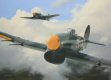  Typhoon! by Ivan Berryman. (PC) |   Red Section Scramble by Ivan Berryman. (PC) |   A Busy Day at the Office by Ivan Berryman. (PC) |   Hard Hitter by Ivan Berryman. (PC) |
No.609 Sqn RAF Artwork |
  Vickers Supermarine Spitfire Mk Ia X4590 PR-F. by M A Kinnear. |   Typhoon Attack by Robert Taylor. |   F/Lt J R Baldwin by Ivan Berryman. |
  Hard Hitter by Ivan Berryman. |   Red Section Scramble by Ivan Berryman. |   Clipped Signature - John Bisdee. |
  Clipped Signature - Ron Grant. |   Clipped Signature - Raymond A Lallemant. |   Spitfire Tally-Ho by Geoff Lea. |
  Spitfires Over the Needles by Philip West. |   Typhoon! by Ivan Berryman. |   A Busy Day at the Office by Ivan Berryman. |
  Supermarine Spitfire MkI by Philip West. |   Supermarine Spitfire Mk 1a by Keith Woodcock. |   Southern Patrol by Philip West. |
  Into the Blue by Simon Atack. |   Typhoon Scramble by Stephen Brown. |   Top Cover by Philip West. |
Return to Aviation Directory Search Home
|
Contact Details |
|
Sign Up To Our Newsletter!
This website is owned by Cranston Fine Arts. Torwood House, Torwoodhill Road, Rhu, Helensburgh, Scotland, G848LE Contact: Tel: (+44) (0) 1436 820269. Email: cranstonorders -at- outlook.com
|
|
|