|
|
|
|
|
||||||||||||||||||||||||||||||||||||||||||||||||||||||||||||||||||||||||||||||||||||||||||||||||||||||||||||||||||||||||||||||||||||||||||||||||||||||||||||||||||||||
 |
|||||||||||||||||||||||||||||||||||||||||||||||||||||||||||||||||||||||||||||||||||||||||||||||||||||||||||||||||||||||||||||||||||||||||||||||||||||||||||||||||||||||||


| SEE HALF PRICE AND FREE PRINT SPECIAL OFFER AVIATION ART PRINTS - ALL SALES FUND OUR HISTORICAL DATABASES - CLICK HERE |

| Click Here For Full Artist Print Indexes | Aviation History Archive |
|
|
334th Fighter Squadron |
|
Name : 334th Fighter Squadron Country : US Known Code Letters : , QP, |
Known Service Details : | |||||||
Pilot or Aircrew | Rank | Start of Service | End of Service | Known Dates | Aircraft | Airframes | Notes |
Captain | unknown | unknown | Shot down and Killed while flying P-47 Thunderbolt 41-6407 by Fw190 over the North Sea off the coast between Ostend and Blankenberghe, Belgium Killed in Action | ||||
October 1942 | 5th May 1944 | Joined French Resistance. | |||||
| Parent Squadrons for : 334th Fighter Squadron | |
| Squadron | Info |
4th Fighter Group Country : US The Eagles. Stationed at Debden. Click the name above to see prints featuring aircraft of 4th Fighter Group | 4th Fighter Group The Eagles. Stationed at Debden. |
| Pilots and Aircrew for : 334th Fighter Squadron | ||
| A list of all aircrew from our database who are associated with this squadron. A profile page is available by clicking their name. | ||
| Name | Info | |
| Allen, Luke Elbert Click the name above to see a profile of Allen, Luke Elbert
| Allen, Luke Elbert Volunteering for the RAF just as the Battle of Britain was reaching its climax, Luke joined 71 Eagle Squadron, flying his first combat operation in April 1941 on Hurricanes. Converting to Spitfires the squadron had a busy period of patrols, sweeps and escorts before transferring to the USAAF as the 334th Fighter Squadron. Luke flew over 60 combat missions in Europe. | |
| Anderson, Stanley Millick Moore Click the name above to see a profile of Anderson, Stanley Millick Moore
| Anderson, Stanley Millick Moore Joined the RAFVR, and Joined 71[Eagle] Sqn RAF, and later transferred to 334th FS, 4th FG, 8th AF USAAF. Shot down and Killed while flying P-47 Thunderbolt 41-6407 by Fw190 over the North Sea off the coast between Ostend and Blankenberghe, Belgium | |
| Brown, Gerald Click the name above to see a profile of Brown, Gerald
| Brown, Gerald Gerald Brown arrived in Europe in August 1943, completing his first tour with the 38th Fighter Squadron, 55th Fighter Group, becoming the first P38 Ace in the 8th Air Force. Volunteering for a second tour, this time flying P-51 Mustangs with the 334th FS, 4th Fighter Group at Debden. In September 1944 he was forced to bail out of his burning P-51 over enemy territory, but escaped to return to his squadron, and completed his second tour in November 1944. Gerry Brown later flew in Korea, but was shot down, spending three years in captivity. Sadly, he passed away on 9th December 2007. | |
| Maxwell, George Click the name above to see a profile of Maxwell, George | Maxwell, George Joining the RAF at the height of the Battle of Britain, George flew combat operations with 71 Squadron, the first Eagle Squadron. In September 1942 the squadron became the 334th Fighter Squadron, 4th Fighter Group, where he notched up a further 86 sorties. Later he served in both Korea and Vietnam. | |
| Pisanos, Spiros Steve Click the name above to see a profile of Pisanos, Spiros Steve
| Pisanos, Spiros Steve Born Nov. 10, 1919, in the Athens suburb of Kolonos, Spiros Nicholas 'Steve' Pisanos, the son of a subway motorman, arrived in America in April 1938 as a crew member on a Greek merchant tramp steamer. Arriving in Baltimore speaking no English, he worked in a bakery and hotels to earn money for flying lessons at Floyd Bennett Field. In August 1940, he settled in Plainfield, New Jersey, and continued flying lessons at Westfield Airport. He earned a private pilot's license and, though still a Greek national, in October 1941 he joined the British Royal Air Force sponsored by the Clayton Knight Committee in New York City. Pisanos began his military flight training at Polaris Flight Academy in Glendale. Upon graduation, Pilot Officer Pisanos was transferred to England where he completed RAF Officers Training School at Cosford, England, and OTU (Operational Training Unit) at Old Sarum Aerodrome in Salisbury. Pisanos was posted to the 268 Fighter Squadron at Snailwell Aerodrome in Newmarket flying P-51A's. He later transferred to the 71 Eagle Squadron, one of three Eagle squadrons in the RAF, comprised of just 244 American volunteers flying Spitfires at Debden RAF Aerodrome. When the USAAF 4th Fighter Group absorbed the American members of the Eagle Squadrons in September and October 1942, Pisanos was commissioned a lieutenant in the U.S. Army Air Forces. Flying his first mission in his P-47 'Miss Plainfield' out of Debden Aerodrome with the 334th Fighter Squadron, 4th Fighter Group, Lt. Pisanos, 'The Flying Greek,' scored his first shootdown on May 21, 1943, when he targeted a German FW-190 over Ghent, Belgium. By Jan. 1, 1944, he had become an ace with five confirmed downings. On March 5, 1944, he obtained his 10th shootdown and while returning from that B-17 escort mission to Limoges and Bordeaux, France, Pisanos experienced engine failure in his P-51B and crash-landed south of Le Havre. For six months he evaded the Germans and fought with the French Resistance and the American OSS, sabotaging the German war machine in occupied France. Lt. Pisanos returned to England on Sept. 2, 1944, following the liberation of Paris. Because of his exposure and knowledge of the French Resistance operations, Pisanos was prohibited from flying additional combat missions because the Air Force could not risk him being captured. Upon returning to the United States, Capt. Pisanos was assigned to the Flight Test Division at Wright Field, Ohio. He attended the USAF Test Pilot School and served as a test pilot at Wright Field and Muroc Lake, California, testing the YP-80 jet aircraft, America's first operational jet. During his Air Force career, Pisanos graduated from the University of Maryland, attended the Air Command and Staff College and the Air War College. Pisanos also served tours of duty in Vietnam (1967-68) and with NORAD before retiring from the USAF with the rank of colonel in in December 1973. Colonel Steve Pisanos died on 6th June 2016. | |
 Died : 28 / 5 / 2009
05-05-1944 - Flown on a bomber escort mission where Steve Pisanos claimed two Me109s and two probable Me109s before suffering engine failure and belly landing the aircraft.
No.66 Sqn RAF
No.71 Sqn RAF
No.610 Sqn RAF
No.309 Sqn RAF
No.308 Sqn RAF
No.340 Sqn RAF
334th Fighter Squadron
21-05-1942 - Joined No.610 Sqn.
15-07-1942 - Joined No.308 Sqn
24-07-1942 - Joined No.309 Sqn
01-10-1942 - Joined 334 Fighter Squadron (USAF) with code XR-K.
12-08-1942 - Joined No.71 Sqn with code XR-K.
03-11-1943 - Joined No.66 Sqn.
15-11-1943 - Joined No.340 Sqn with code GW-W.
07-12-1943 - Damaged on operations.
02-05-1945 - Damaged in belly landing near Felton, Northumberland after engine failure on take off.
30-05-1945 - Struck off.
21-05-1944 - Flown by Steve Pisanos.
15-04-1944 - Stanley Millick Moore Anderson of334th FS, 4th FG, 8th AF USAAF. was shot down in P-47 41-6407 by a Fw190 over the North Sea off the coast between Ostend and Blankenberghe, Belgium . Pilot was killed in action KIA 15-4-44.
Known Individual Aircraft of 334th Fighter Squadron : | ||||||||
Type | Serial | Codes | First Flew | Squadron History | Aircrew History | History Notes | Engine | Factory |
QP-D | - | |||||||
XR-K | - | Merlin 45 | Castle Bromwich Aircraft Factory | |||||
QP-D | - | |||||||
QP-E | - | Pratt & Whitney R-2800 Double Wasp engine | ||||||
| Aircraft for : 334th Fighter Squadron | ||
| A list of all aircraft associated with 334th Fighter Squadron. A profile page including a list of all art prints for the aircraft is available by clicking the aircraft name. | ||
| Aircraft | Info | |
Mustang 
Manufacturer : North American | Mustang The ubiquitous North American P-51 Mustang, which many consider to be the best all-around fighter of WW II, owes its origins to the British Air Ministry. Following Britains entry into WW II in 1939, the RAF was interested in purchasing additional fighter aircraft from American sources, particularly the Curtiss P-40. Curtiss, which was busy, was unable to guarantee timely delivery so the British approached North American Aviation as a possible second source for the P-40. North American chose to propose its own fighter design which would use the same Allison engine as the P-40. Utilizing new laminar flow wings, the North American fighter was expected to have performance better than the P-40. Developed in record time the new aircraft was designated as a Mustang I by the Brits, whereas the USAAF ordered two for evaluation which were designated XP-51 Apaches. Intrigued with the possibility of using this aircraft also as a dive bomber, North American proposed this to the USAAF which decided to order 500 of the P-51 aircraft to be modified for dive bombing use. Designated as the A-36 Invader, this version of the Mustang utilized dive flaps, and bomb racks under each wing. Some reinforcing of the structural members was also required because of the G-forces to be encountered in dive bombing. A-36s entered combat service with the USAAF prior to any P-51s. In early 1943 the 86th and 27th Fighter Bomber Groups of the 12th Air Force began flying A-36s out of Northern Africa. Despite some early problems with instability caused by the dive flaps, the A-36 was effective in light bombing and strafing roles. It was not, however, capable of dog fighting with German fighters, especially at higher altitudes. Despite these drawbacks one USAAF pilot, Captain Michael T. Russo, who served with the 16th Bomb Squadron of the 27th Fighter Bomber Group, was credited with five confirmed aerial victories in the A-36, thereby becoming the first mustang ace. | |
Thunderbolt 
Production Began : 1943 Number Built : 15683 | Thunderbolt Alexander Kartveli was a engineer with Seversky Aircraft who designed the P-35, which first flew in 1937. With Republic Aviation Kartveli supervised the development of the P-43 Lancer. Neither of these aircraft were produced in large numbers, and neither was quite successful. However, the Republic Aviation P-47 Thunderbolt, also nicknamed the Jug, was quite a different story. The Jug was the jewel in Kartvelis design crown, and went on to become one of the most produced fighter aircraft of all time with 15,683 being manufactured. The P-47 was the largest and heaviest single seat fighter of WW II. The P-47 immediately demonstrated its excellent combat qualities, including speed, rate of climb, maneuverability, heavy fire power, and the ability to take a lot of punishment. With a wingspan of more than 40 feet and a weight of 19,400 pounds, this large aircraft was designed around the powerful 2000 HP Pratt and Whitney R-2800 Double Wasp radial engine. The first P-47 prototype flew in May of 1941, and the primary variant the P-47D went into service in 1943 with units of the U.S. Armys Eighth Air Force. The Jug had a maximum speed in excess of 400 MPH, a service ceiling in excess of 42,000 feet, and was heavily armed with either six or eight heavy caliber machine guns. With its ability to carry up to a 2,500 pound bomb load, the Jug saw lots of use in ground attack roles. Until the introduction of the N model, the P-47 lacked the long range required for fighter escort missions which were most often relegated to P-51 Mustangs or P-38 Lightnings. In his outstanding painting entitled Bridge Busting Jugs, noted aviation artist Stan Stokes depicts Eighth Air Force Jugs in a ground attack mission in the Alps in June of 1944. The top P-47 ace was Francis Gabreski who had flown with the 56th Fighter Group, the first unit to be equipped with the P-47. In August of 1943 Gabreski attained his first aerial combat victory (over an Fw-190) and by years end he had reached ace status with 8 confirmed victories. As Commander of the 61st Squadron, Gabreski continued to chalk up victory after victory, and on seven different occasions he achieved two victories during the same mission. However, in July of 1944 Gabreski damaged the prop on his Jug during a low level attack on an airfield near Coblenz. Forced to make a crash landing, he was captured and remained a prisoner of war until Wars end in 1945. Following the War Gabreski returned to military service with the Air Forces 4th Fighter-Interceptor Wing in Korea. Flying the F-86 Sabre Jet, Gabreski attained 6.5 more aerial victories in 1951 and 1952 becoming an ace in two different wars | |
Last edited : 20:20, January 7, 2018
Last editor : HMS
  Devastating Thunder by Brian Bateman. |  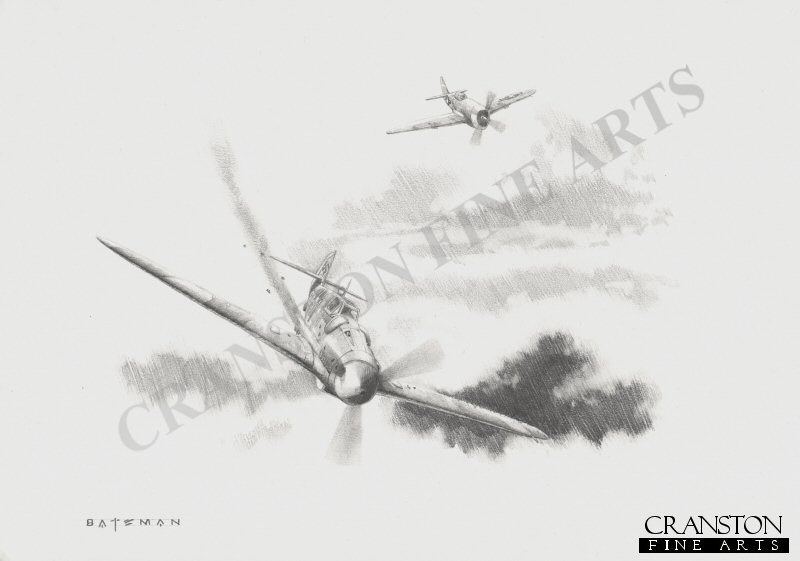 Victory for Red Section by Brian Bateman. |   Greek Victory by Brian Bateman. |   Victory for White Two by Brian Bateman. |
334th Fighter Squadron Artwork |
  Devastating Thunder by Brian Bateman. (P) | Victory for White Two by Brian Bateman. | Greek Victory by Brian Bateman. |
Victory for Red Section by Brian Bateman. | Devastating Thunder by Brian Bateman. |
Return to Aviation Directory Search Home
|
Contact Details |
|
Sign Up To Our Newsletter!
This website is owned by Cranston Fine Arts. Torwood House, Torwoodhill Road, Rhu, Helensburgh, Scotland, G848LE Contact: Tel: (+44) (0) 1436 820269. Email: cranstonorders -at- outlook.com
|
|
|