|
|
|
|
|
 |
|||
|
|
|
|
|
|
|
|||
| Click Here For Full Artist Print Indexes | Aviation History Archive |
|
Aviation Art Prints  Aviation Postcards Aviation Postcards  World War One World War One |
[UP] - World War One - World War Two - Modern Era - Spitfire - Lancaster - Mosquito - Typhoon - Tempest - Hurricane - Mustang - Me109 |
| Navigation | |
| Page 1 of 9 | Page 1 .. Next |
|
|
|
|
|
|
|
|
|
|
|
|
|
|
|
|
|
|
|
|
|
| Navigation | |
| Page 1 of 9 | Page 1 .. Next |
| Text for the above items : |
Brandenburg D.1 by Ivan Berryman. (PC) Designed by the great Ernst Heinkel, the diminutive D.1 was an essential stop-gap that provided the Austro-Hungarian pilots with a front line fighter until they were able to re-equip with Albatros scouts in the Summer of 1917. This little aircraft performed well and was generally held in high regard by its pilots, although it did have some shortcomings, namely that forward vision was extremely limited and the Schwarzloses gun was completely concealed in the overwing pod that made it inaccessible in the air. Most unusual of all was its interplane strut arrangement, designed to reduce drag, which gave it the nicknames Starstrutter or Spider. These examples are shown passing above the German cruiser Derfflinger. |
Oberleutnant Lothar Freiherr von Richthofen by Ivan Berryman. (PC) On the evening of 7th May 1917, a fierce battle took place involving aircraft of Jasta 11 and 56 Sqn RFC, the former led by the brother of the Red Baron, Lothar von Richthofen. As the sun dipped beneath the heavy clouds, most expected the dogfight to break off in the fading light, but an extraordinary duel between the RFCs Captain Albert Ball and Lothar von Richthofen broke out, the two aircraft flying directly at each other, firing continuously, then turning and repeating the manoeuvre. Lothars all red Albatross was damaged, but landed safely. Albert Balls SE5, however, was seen by observers to fall through the heavy cloudbase inverted, before crashing heavily, fatally wounding Ball. |
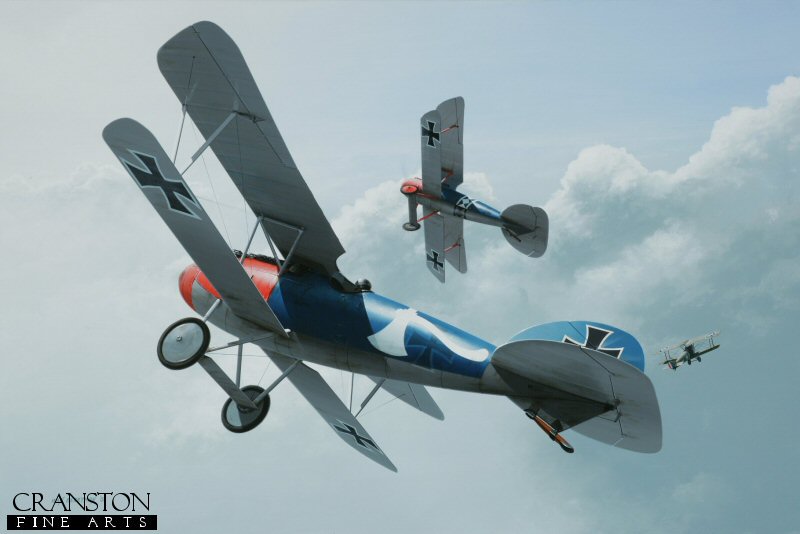
Leutnant d R Paul Strahle by Ivan Berryman. (PC) The distinctive blue and red livery of these two Albatros D.Vs identify them as Jasta 18 machines in Berthold Colours, a reference to their commander at that time, Oblt Rudolf Berthold. The nearest aircraft is that of Leutnant der Reserve Paul Strahle who scored six victories with this unit before taking his aircraft (4594/17) with him to Jasta 57 where he would score a further 8. Each aircraft carried a personal emblem, in the case of Strahle a white axe whilst the similar aircraft of Ltn d R Arthur Rahn displays a diamond pattern. The fuselage crosses on both aircraft were crudely painted over and are still just visible beneath the blue. |
Captain Ivan Smirnov by Ivan Berryman. (PC) After service in the 96th Infantry Regiment, Smirnov joined the XIX Corps Air Squadron in 1914, shooting down twelve enemy aircraft in the course of two years. When revolution swept through Russia in November 1917, he escaped the Bolsheviks via a White counter-revolutionary route, eventually joining the RAF in England, serving at the Central Flying School at Upavon. He is shown here in his silver Nieuport 17, having just despatched a Roland C.II. |
Tribute to Freddie West VC by Ivan Berryman. (PC) On the 11th of August 1918, the Armstrong Whitworth FK8 C8602 of Ferdinand 'Freddie' West and his observer / gunner John Haslam was one of hundreds of aircraft tasked with locating German reserves on the ground to assist the Army. A gap in the clouds revealed a concentration of German troops - they dived low to assess their number but coming under intense fire returned to the clouds. Not satisfied that the enemy positions had been identified correctly, West dived again. Attacked by several aircraft and wounded, West pressed on with his low flight to gather further intelligence. Finding 'troops, guns and vehicles in all directions', they knew they had found the German reserves. Turning for home they encountered more German scouts. This time, the attack left their aircraft badly damaged and West was hit in the leg by five bullets, one of which severed an artery. With Haslam taking aim at the fighters while West tried to take evasive action, they managed to escape. Half fainting through blood loss, West fashioned a tourniquet from a leg of his shorts, and drifting into semi-consciousness, landed the aircraft behind Allied lines. He insisted that he should personally pass on the intelligence to his No.8 Sqn superiors, and lost consciousness after doing so. Sir John Salmond, in charge of the Air Force in France, put him forward for the Victoria Cross which was awarded for 'unparalleled pluck and endurance. The valour displayed by this officer has throughout been a magnificent example to his flight, which he has inspired with his devotion, courage and power of endurance.' Despite losing his leg, with an artificial limb he returned to flying duties after the war and remained in the Royal Air Force until the end of World War Two. He died in 1988. |
The Rittmeister by Ivan Berryman. (PC) The greatest ace of WW1, Manfred von Richthofen, the Red Baron is depicted here flying Fokker Dr.1, serial No 425/17, in its final guise following the introduction of the Balkenkreuze. This was the only Triplane flown by the Rittmeister that was painted all red and was also the aircraft in which he lost his life on 21st April 1918, the celebrated ace having scored a confirmed 80 victories against allied aircraft over France. |
Captain William Billy Bishop by Ivan Berryman. (PC) Undoubtedly one of the truly great Aces of the First World War, William Billy Bishop became celebrated for his technique of actively seeking out the enemy and bringing the fight to him, rather than the more usual practice of patrolling in search of enemy activity. An example of this was his single-handed attack on a German airfield in June 1917 when he destroyed not only a number of aircraft on the ground, but then successfully despatched another seven Albatross scouts that took off to engage him. For this action, he was awarded the Victoria Cross in August 1917 and his final tally when the war ended was 72 confirmed victories. He is depicted here in his Nieuport Scout B1566 in combat with a Pfalz D.III. |
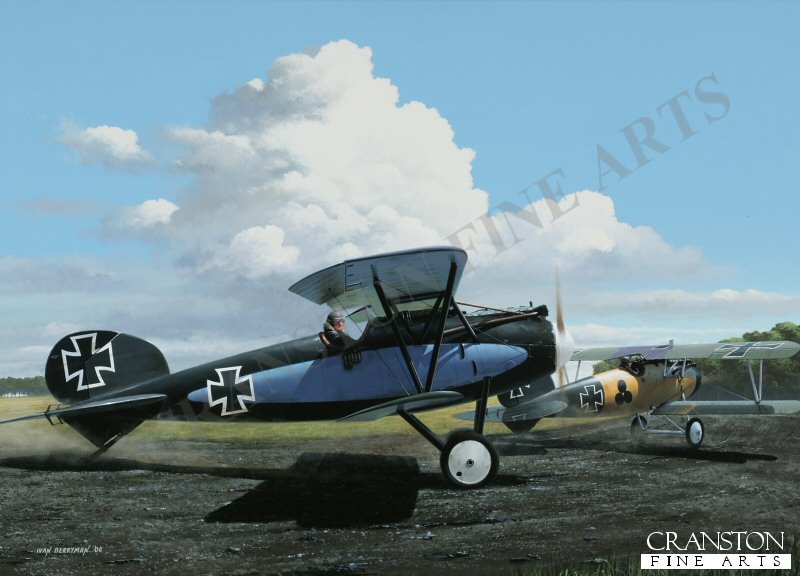
Leutnant d R Viktor Schobinger by Ivan Berryman. (PC) The distinctive black-fuselaged Albatross D.V of Jasta 12s commander taxis out for take off behind the similar machine of Leutnant d R Friedrich Hochstetter at Roucourt, late in 1917. Whilst all of Jasta 12s aircraft possessed black tails, many of them bore their pilots personalised insignia painted large on the fuselage sides. In the case of Hochstetter, it was a stacked shot emblem, whilst others sported castles, diagonal crosses or various geometric shapes. The origin of Schobingers light blue design is unknown, but may have been applied purely for recognition purposes. His final tally was eight victories, while Hochstetter scored just one. |
Difficult Journey Home by Ivan Berryman. (PC) Handley Page 0/400s are attacked by German Albatross fighters as they return home from a raid during 1918. |
The First Ace - Max Immelmann by Ivan Berryman. (PC) Perhaps the greatest exponent of Fokker's Eindecker series of aircraft, Max Immelmann is credited with 15 aerial victories and was the first fighter pilot ever to win the coveted Pour le Mérite. He was killed on 18th June 1916 during combat with British FE.2B fighters of 25 Sqn. |
James McCudden by Ivan Berryman. (PC) SE5As of B Flight, 56 Sqn led by James McCudden in the aircraft numbered B519, on patrol over the Western Front in 1917. |
Tribute to Julius Buckler by Ivan Berryman. (PC) Having been wounded early in World War One as a soldier on the Western Front, Julius Buckler had become a pilot with Jasta 17 by November 1916. He scored his first victory that December, one of almost 30 enemy aircraft. Frequently out of action due to wounds including simultaneous broken arms, he is seen here flying his Albatros D.III names Mops, the aircraft he used to claim his first balloon victory on 26th April 1917. He went on to score 7 balloon victories and was awarded the Blue Max. He died in 1960 aged 66. |
Oberleutnant Hermann Goring by Ivan Berryman. (PC) Synonymous with both World Wars, the young Hermann Goring scored his first victory on 16th November 1915, shooting down a Maurice Farman over Tahure. A year later, he was injured in combat, but managed to land his bullet-riddled aircraft near a field hospital. Goring steadily increased his score to an eventual 22 victories and is shown here on patrol in his characteristic all-white Fokker D.VII. |
The Best Fighting Unit in the LFT by Ivan Berryman (PC) During 1917 under the leadership of Hauptmann Godwin von Brumowski Flik 41J was to become recognized as the finest of all the Fliegerkompanie in the Austro-Hungarian Army Air Service. With the superb Albatros D.III (Oef), the Luftfahrtruppen (LFT) were equipped to take on the enemy on equal terms. |
Leutnant der Reserve Erwin Bohme by Ivan Berryman. (PC) Albatros C.III C.766/16 was among the most distinctively-painted aircraft of World War 1, its fuselage sides decorated with a dragon motif on the starboard side and a stylised crocodile on the other, both apparently chasing a tiny white biplane. This was the aircraft shared by Erwin Bohme and his observer, Leutnant Ladermacher while serving with Jasta 10 on the Eastern Front in August 1916. Bohme was soon chosen to fly with the great Oswald Boelke with Jasta 2, the latter being tragically killed in a collision with Bohme on 28th October during an aerial combat with DH.2s of 24 Sqn. This tragedy haunted Bohme for many months to come, but he went on to score 24 confirmed victories before falling victim to an FK.8 on 29th September 1917. Their Albatros C.III is shown picking off a Russian Nieuport 12, his first kill on 2nd August 1916. |
AEG G.IV by Ivan Berryman. (PC) Although not as well known as the Gotha series of bombers, the Allgemeine Elektricitats-Gessellschaft G.IV acquitted itself well in the closing stages of World War 1, although its limited fuel load restricted it to short range duties and reconnaissance missions. The G.IV was popular with its crews because it was extremely robust and featured such state of the art developments as onboard radios and electrically-heated flying suits and was an easy aircraft to fly. Kampfgeschwader 4 are specially noted for flying their G.IVs up to seven missions a night on the Italian front. |
Grid Caldwell by Graeme Lothian. (PC) Grid Caldwell, the top New Zealand Ace with 25 victories in his SE5A of 74 Squadron, is shown taking off from his home airfield during the Great War. Keith Logan (Grid Caldwell) was born 16th October 1895. At the outbreak of World War One, Caldwell joined the territorial army. He attempted to enlist with the New Zealand expeditionary force destined for Gallipoli but was refused. In October 1915 he paid the sum of £100 to join the first class of the New Zealand Flying School. In January 1916 Grid Caldwell arrived in England and was commissioned into the Royal Flying Corps in April that year. In July 1916 he was posted to No.8 Squadron, flying BE2Cs and Ds on observation duty. It was on 18th September 1916 his first aerial victory was scored, shooting down a Roland CII. He transferred to 60 Squadron in November and flew Nieuport 17 fighters and was promoted to Captain in February 1917. During this period he scored further victories, shooting down Albatros Scouts, and on 17th September was awarded the Military Cross. In October 1917 he was posted back to England as an instructor. In March 1918, promoted to Major, he was given command of 74 Squadron RAF flying SE5As. The squadron under his command was credited with 140 aircraft destroyed and 85 out of control. This tally was scored in the last eight months of the war with the loss of only 15 pilots killed or taken prisoner. During his wartime flying, he had fought dogfights with German aces Werner Voss and Herman Becker, and he once survived a mid-air collision, bringing his badly damaged aircraft to ground level, jumping out before it crashed. He was credited with 11 aircraft destroyed, 3 shared destroyed or captured and 10 out of control, and 1 further shared out of control. During World War Two he was station commander at Woodbourne and later Wigram and posted to India in 1944. After the war he was made commander of the British Empire. He retired from the RNZAF in 1956, and sadly died of cancer in Auckland on 28th November 1980. |
Tribute to 8 Naval Squadron by Ivan Berryman. (PC) In this painting, the Sopwith Triplane N5468 named ANGEL of No.8 Naval Squadron is depicted around the time it was flying from St. Eloi in France in the summer of 1917. This aircraft clocked up more than 150 flying hours here before being sent to a training squadron at the end of the year. During this time, Captain Charles Jenner-Parson claimed at least two victories in this aircraft. |
Red Danger by Ivan Berryman. (PC) The Red Baron in one of his Albatross scouts instead of the Fokker DR.1 Triplane with which he is more often associated. History records that no fewer than 56 of his victims fell to the guns of a succession of Albatros scouts, so I have depicted him here flying D.III Nr.2253/17 in which he claimed (among others) victory number 52, his last in this aircraft before taking some long-overdue leave. He went on to become the highest scoring ace of World War 1 with 80 confirmed victories to his credit before his untimely death in April 1918. |
Aviatik B.1 by Ivan Berryman. (PC) Based upon the design of an earlier 1913 racing biplane, Aviatik AG were able to introduce their B.1 into military service almost at the outbreak of World War 1, the type proving to be a useful reconnaissance machine during the early stages of the conflict. As with most B type aircraft of this time, the Aviatik B.1 was unarmed and carried an observer in the forward cockpit. Power was provided by a Mercedes D.1 inline engine whose large radiators were fitted to the port side of the fuselage, just above the lower wing. There is no record of exactly how many B.1s were constructed. |
Oberleutnant Erich Lowenhardt by Ivan Berryman. (PC) Erich Lowenhardt was already the holder of the Knights Cross 1st and 2nd Class for acts of bravery even before becoming a pilot. After serving as an observer for a year, he was eventually posted to Jasta 10 in 1917 where he immediately began to score victories, sending down balloons and enemy aircraft at a fearsome rate. He was appointed Commander of Jasta 10 one week before his 21st birthday, making him one the youngest pilots to rise to such a rank in the German Army Air Service. He continued to increase his score steadily throughout 1917 and 1918, but was involved in a mid-air collision with a Jasta 11 aircraft on 10th August. Lowenhardt elected to abandon his aircraft, but his parachute failed to deploy and the young ace fell to his death. He flew a number of aircraft, but this yellow-fuselaged Fokker D.VII was his most distinctive and is believed to be the aircraft in which he was killed. His final victory total was 54. |
|
Contact Details |
|
Sign Up To Our Newsletter!
This website is owned by Cranston Fine Arts. Torwood House, Torwoodhill Road, Rhu, Helensburgh, Scotland, G848LE Contact: Tel: (+44) (0) 1436 820269. Email: cranstonorders -at- outlook.com
|
|
|